🏭 Open-Die Forging Since 2008🌐 Exporting to 40+ Countries✅ ISO 9001:2015 Certified · EN 10204 3.1 (3.2 on request)📞 +86-189-2135-9659💬 WhatsApp
A286 / UNS S66286 / 1.4980 / SUH 660 Forging Parts 🇺🇸 USA · 🇪🇺 Europe · 🇯🇵 Japan — AMS 5731 / 5732 / 5734 / 5737 · ASTM A638 Grade 660 · ASTM A453 Grade 660 · EN 10269 / EN 10302 · JIS G 4311
Published: |
Last updated: |
Technically reviewed by Jiangyin Jiangnan Metal Co., Ltd. Metallurgical Engineering Team
A286 / UNS S66286, key facts at a glanceVerified against AMS, ASTM, EN and JIS source standards · reviewed 19 Sep 2026
What it is
A286 (UNS S66286) is an iron–nickel–chromium, austenitic,
precipitation-hardenable superalloy, approximately 25 % Ni,
15 % Cr, 1.2 % Mo, 2.1 % Ti, balance iron, strengthened by ageing
precipitation of ordered FCC γ′ Ni₃(Al,Ti). Authoritative sources
(ATI, Carpenter, the title of ASTM A638) classify it as an
iron-based superalloy rather than a stainless steel, although UNS, EN and JIS
all catalogue it inside their stainless / heat-resisting steel families.
Load-bearing limit 704 °C (1300 °F): this is the number that
governs design; above it γ′ coarsens and transforms to η-phase Ni₃Ti.
Oxidation limit 816 °C (1500 °F) continuous, 982 °C
(1800 °F) intermittent. A286 survives 816 °C but must not be
loaded above 704 °C.
High route 982 °C (1800 °F) solution → coarser grain, best
creep and stress-rupture life (AMS 5731 / 5732, ASTM A638 Type 2, A453 Class B).
Low route 899 °C (1650 °F) solution → finer grain, higher
short-time tensile (AMS 5734 / 5737, ASTM A638 Type 1, A453 Class A).
Both age at 704–760 °C, 16 h minimum, air cool
(common practice 720 °C / 16 h).
Forging window
1040–1120 °C (1900–2050 °F); do not forge below
927 °C (1700 °F).
Physical
Density 7.94 g/cm³ (0.287 lb/in³) ·
E = 201 GPa (29.1 × 10⁶ psi) ·
non-magnetic, μr 1.007–1.010 in all conditions and down to
−196 °C · melting range 1370–1400 °C.
Manufacturer of record
Jiangyin Jiangnan Metal Co., Ltd., open-die forging factory,
No.1 Chengxiqiao Road, Zhouzhuang Town, Jiangyin City, Jiangsu Province, China
(214423). In-house VIM and VIM-VAR vacuum melting; forged discs to
Ø 1,500 mm, seamless rolled rings to 1,800 mm OD, shafts to 6 m,
bar Ø 25–400 mm, single-piece weight to 5,000 kg. ISO 9001:2015;
EN 10204 3.1 standard, 3.2 on request.
sales@steelforgepieces.com ·
+86-189-2135-9659.
Published evidence
24 consecutive aerospace heats (Aug 2024 – Jan 2026) published in full
on this page with chemistry and tensile results: mean UTS 1,057 MPa
(σ 15.6, Cpk 3.46), mean YS 678 MPa
(σ 14.2, Cpk 2.15), mean elongation 23.2 %,
100 % conformity to AMS 5732. See the dataset →
Jiangyin Jiangnan Metal Co., Ltd. operates in-house VIM and VIM-VAR
melting furnaces to produce aerospace-grade A286 open-die forgings, the iron-based
precipitation-hardening superalloy that has been the workhorse jet-engine fastener material
since the 1950s. Owning the primary melting line gives us full chemistry and inclusion-cleanliness
control from the raw scrap charge all the way through final aged forging, with single-heat
traceability documented on every MTC. We supply under all three major international
standards: AMS 5732 / ASTM A638 Grade 660 (USA),
EN 10269 / 1.4980 (Europe), and
JIS SUH 660 / G 4311 (Japan)
— with cross-certification available on request. Our specialty is gas turbine disc forgings,
AMS-certified bolt stock, and high-temperature ring forgings, all in the
solution + aged condition (720 °C / 16 h / air cool) that delivers
~1,000 MPa UTS with useful strength retention to ~700 °C. Available shapes include forged
discs to Ø 1,500 mm, seamless rolled rings to 1,800 mm OD, fastener bar stock 25–400 mm Ø,
and custom near-net forgings, with EN 10204 3.1 standard and 3.2 third-party witness on
request.
Designation note: A286, UNS S66286, Alloy 660, ASTM A638 Grade 660, DIN 1.4980,
and JIS SUH 660 are generic designations and not trademarks. The original
alloy was developed under NACA (now NASA) sponsorship at Allegheny Ludlum in the 1950s; the
relevant patents have long since expired. Any qualified producer that meets the chemistry
and mechanical-property requirements of the chosen national standard may legally produce
and sell A286 under any of these names.
🇺🇸 USA
A286 UNS S66286
🇪🇺 Europe
1.4980
🇯🇵 Japan
SUH 660
ASTM
A638 Gr 660 A453 Gr 660
AMS
5731 / 5732 5734 / 5737
UTS aged
145 ksi
YS aged
85 ksi
Service
~700 °C
Density
7.94
🔎
Multi-Standard Designation Lookup
Type any name (A286, S66286, AMS 5732, 1.4980, SUH 660, X6NiCrTiMoVB…) and instantly see all international equivalents
Exclusive
✓ All these names refer to the same alloy. Jiangyin Jiangnan Metal Co., Ltd. ships UNS S66286 with a multi-designation MTC.
Available A286 / UNS S66286 / Alloy 660 Forged Products
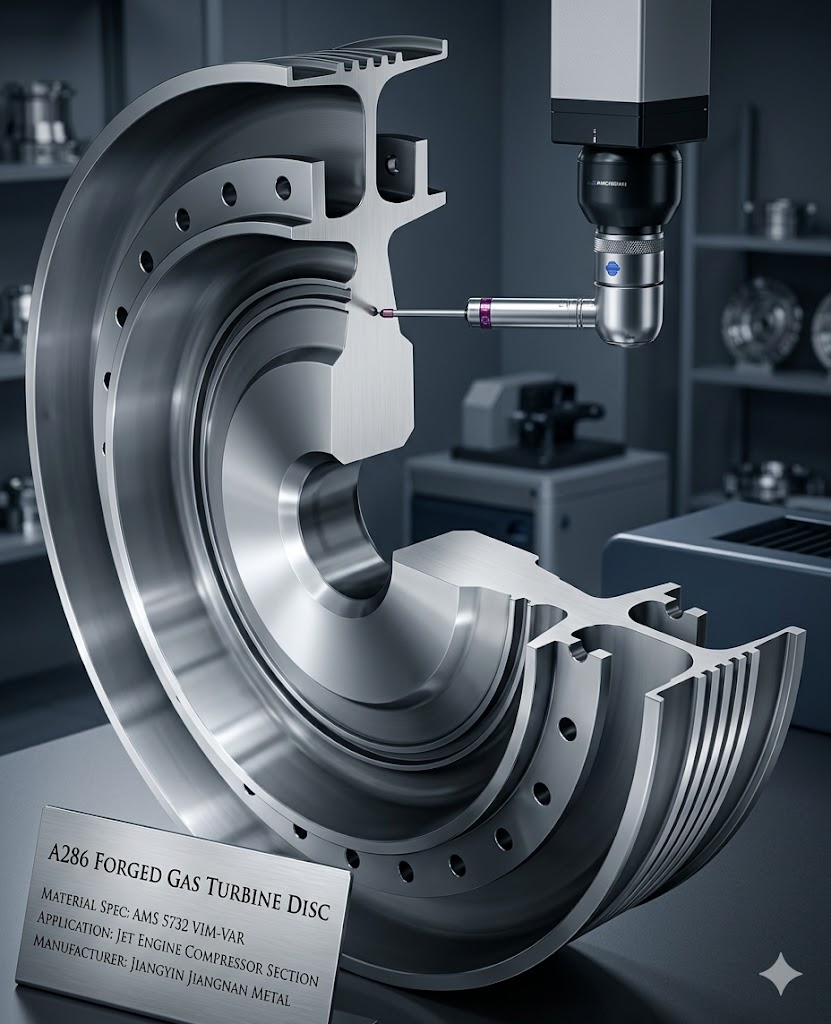
A286 Forged Gas Turbine Disc
Ø 300 – 1,500 mm · solution + aged
AMS 5732 (982 °C solution + age) · VIM-VAR melt
🔩
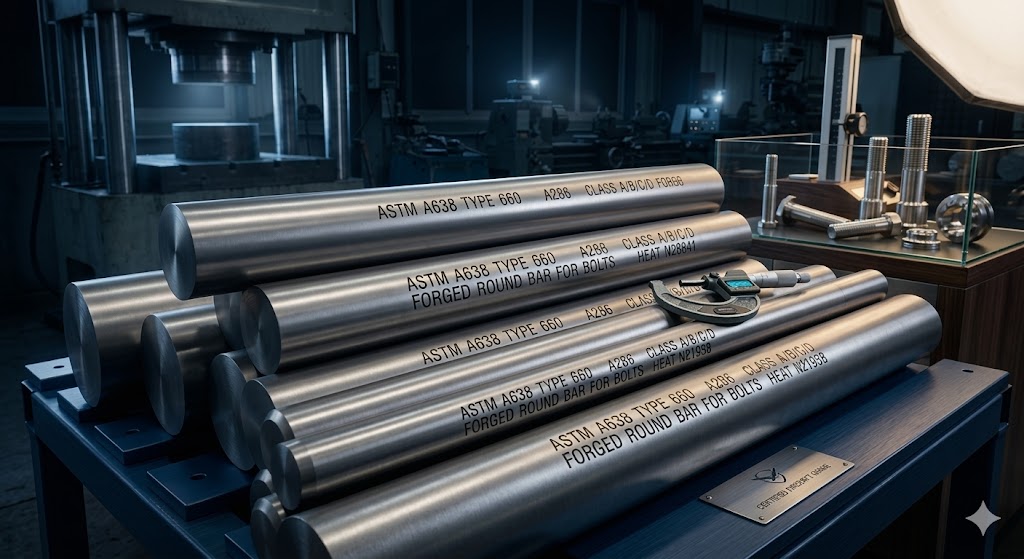
ASTM A638 Grade 660 Forged Round Bars for Bolts
ASTM A638 Grade 660 Forged Round Bars for Bolts
Ø 12 – 75 mm · solution + aged
ASTM A638 Gr 660 Type 1/2 · ASTM A453 Gr 660 Cl. A–D · AMS 5732 / 5737
⭕
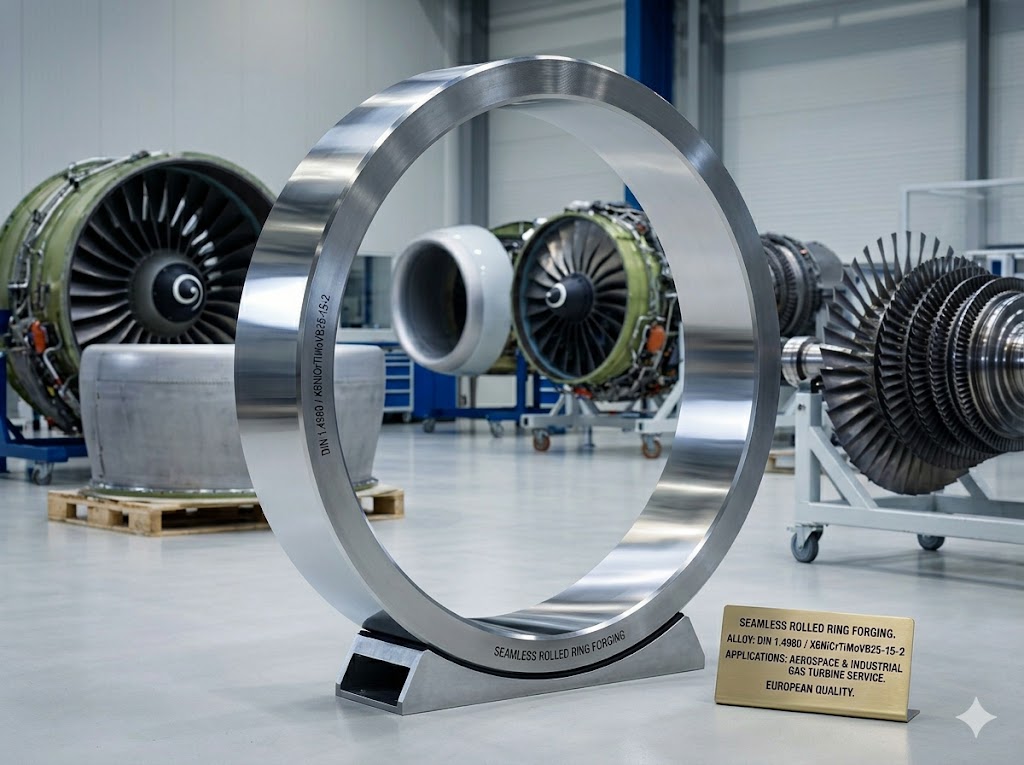
DIN 1.4980 Seamless Rolled Ring Forging
1.4980 Seamless Rolled Ring Forging
OD up to 1,800 mm · EN 10269 / EN 10302
For European aerospace tier-1 supply chains
🔧
JIS SUH 660 Forged Valve Stem
SUH 660 Forged Valve Stem
Ø 20 – 150 mm · JIS G 4311 STA
Japanese industrial & steam turbine market
🛠
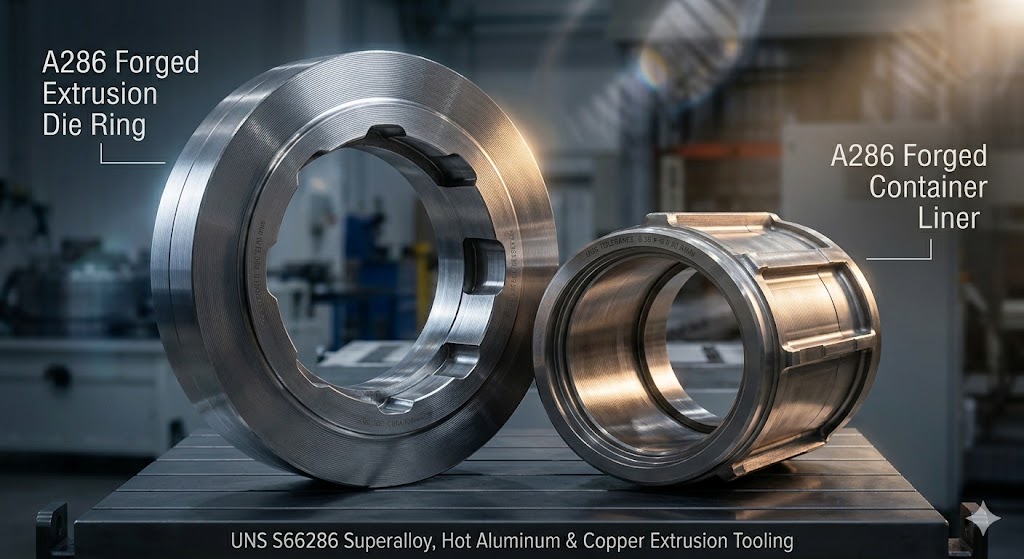
A286 Forged Extrusion Die Ring & Liner
A286 Forged Extrusion Die Ring & Liner
OD 200 – 1,200 mm · solution + aged
Aluminum / copper hot extrusion press tooling
✈️
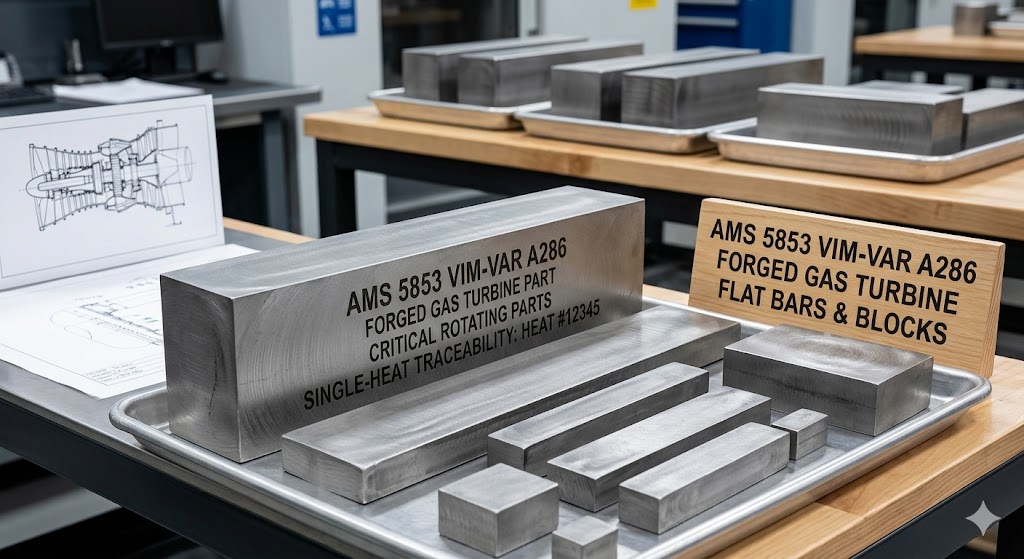
VIM-VAR A286 Forged Gas Turbine Flat Bars & Blocks
VIM-VAR A286 Forged Gas Turbine Flat Bars & Blocks
200 – 600 mm width · in-house VIM-VAR
Critical rotating parts · single-heat traceability
What Is A286 / UNS S66286? Composition, Structure and Classification
A286 (UNS S66286) is an iron-based, austenitic, precipitation-hardenable superalloy of approximately 25 % nickel, 15 % chromium, 1.2 % molybdenum and 2.1 % titanium with small vanadium, aluminium and boron additions, balance iron. Ageing precipitates ordered FCC γ′ Ni₃(Al,Ti) in the austenite matrix, giving roughly 1,000 MPa tensile strength at room temperature and useful load-bearing strength to 704 °C (1300 °F). It is non-magnetic in every condition and ductile to −196 °C. Developed under NACA sponsorship at Allegheny Ludlum in the 1950s, it remains the dominant jet-engine fastener alloy. Jiangyin Jiangnan Metal Co., Ltd. forges A286 in this grade from its own VIM and VIM-VAR melt, in Jiangyin, Jiangsu, China.
A286 (UNS S66286 / Alloy 660 / 1.4980) is an iron-based, austenitic,
precipitation-hardenable superalloy originally developed in the 1950s under NACA (now NASA)
sponsorship at Allegheny Ludlum. The composition, roughly 25% Ni, 15% Cr, 1.2% Mo, 2.1% Ti,
plus small additions of Al, V, and B, produces a face-centered-cubic austenitic matrix
strengthened by precipitation of a γ′ (Ni₃(Ti,Al)) phase during aging. The result is an
alloy with strength competitive with low-alloy steels at room temperature and useful
strength retention up to ~700 °C (1300 °F).
A286 occupies a specific niche in the high-temperature alloy family: it is significantly
cheaper than nickel-based superalloys (Inconel 718, Waspaloy) but offers higher service
temperature and creep resistance than precipitation-hardening martensitic stainless steels
(17-4 PH,
PH 13-8 Mo,
which are limited to ~315 °C). For the past 70 years it has been the dominant choice for
jet-engine fasteners (manifold studs, turbine bolts), gas turbine compressor discs, and
structural high-temperature components in commercial and military aerospace.
The alloy is fully austenitic and remains non-magnetic in all conditions —
a property that distinguishes it from PH stainless grades (which are martensitic and
magnetic). It also retains good ductility and toughness at cryogenic temperatures, which is
why A286 has seen significant use in liquid-fuelled rocket engines (LH₂ / LOX service) and
some cryogenic structural applications.
A286 Equivalent Designations: US, Europe, Japan, UK and France
A286, UNS S66286, Alloy 660, ASTM A638 Grade 660, ASTM A453 Grade 660, DIN 1.4980 (X6NiCrTiMoVB25-15-2), FE-PA2601 / 1.4944, JIS SUH 660, BS HR 51 / HR 52 and AFNOR E-Z 6 NCT 25 all designate the same alloy. The major alloying elements are harmonised across them; the differences are confined to trace-element limits. Two grades are widely but wrongly listed as A286 equivalents and are not: BS S151 is Jethete M152, a martensitic 12 % Cr steel limited to about 560 °C, and Russian ХН35ВТЮ / ЭИ787 is a higher-nickel, tungsten-bearing alloy. There is no exact GOST equivalent to A286. Jiangyin Jiangnan Metal Co., Ltd. certifies forgings against whichever of these standards appears on the drawing, and issues multi-designation material test certificates.
A286 is supplied under three major international standards bodies: USA
(UNS / ASTM / AMS), Europe (DIN / EN), and Japan (JIS). All three standards specify the same
iron-based precipitation-hardening alloy, but composition limits and
mechanical-property minimums differ slightly between them, most in
trace-element controls (P, S, B, Cu). The tables further below give a precise side-by-side
comparison so engineers can verify equivalence for their specific procurement standard.
Jiangyin Jiangnan Metal Co., Ltd. accepts orders under all of these callouts and certifies
UNS S66286 forgings to the matching national standard.
Table 0. A286 / UNS S66286 Equivalent Designations by Country and Standards Body
Country / Body
Designation
Governing Standard / Notes
🇺🇸 USA · UNS
UNS S66286
Generic Unified Numbering System designation
🇺🇸 USA · Common Name
A286 · Alloy 660
Original NACA / Allegheny designation; "Alloy 660" derives from ASTM A638 Grade 660
🇺🇸 USA · ASTM
ASTM A638 Grade 660 Type 1 / Type 2
Bars and forgings for high-temperature service
🇺🇸 USA · ASTM (bolting)
ASTM A453 Grade 660 Class A/B/C/D
High-temperature bolting (bars, bolts, studs, nuts). This is the spec that carries Classes A–D — not A638.
🇺🇸 USA · AMS (bars/forgings/rings)
AMS 5731
Solution heat treated at 1800 °F (982 °C). Supplied for further fabrication or customer-performed aging.
🇺🇸 USA · AMS (bars/forgings/rings)
AMS 5732
1800 °F (982 °C) solution + precipitation heat treated. Min 130 ksi / 85 ksi. Best creep & stress-rupture route.
🇺🇸 USA · AMS (bars/forgings)
AMS 5734
1650 °F (899 °C) solution heat treated only, no aging. Low-solution counterpart of AMS 5731.
🇺🇸 USA · AMS (bars/forgings)
AMS 5737
1650 °F (899 °C) solution + precipitation heat treated. Min 140 ksi / 95 ksi, the higher-tensile route.
🇺🇸 USA · AMS (bars & wire)
AMS 5853
1800 °F solution treated and work-strengthened, consumable-electrode melted, 160 ksi (1103 MPa) capability. Bar & wire for high-strength fasteners, not a forging-quality spec.
EN 10302 (creep-resistant steels), EN 10269 (fasteners). Tightest sulfur limit; minimum-boron specified.
🇪🇺 Europe · aerospace (EN)
FE-PA2601 · 1.4944
The European aerospace callout for A286-type bar and bolts. EN 2398 (bar for machined bolts), EN 2576 (MJ bolts), EN 3043. Distinct from the industrial 1.4980 callout.
🇯🇵 Japan · JIS
SUH 660
JIS G 4311 (heat-resisting steel bars); equivalent to A286 with JIS-specific trace-element bands
🇰🇷 Korea
SUH 660 (KS / JIS harmonized)
Korea typically procures to JIS SUH 660 directly or to AMS 5732 for aerospace. No separate KS chemistry, fully aligned with JIS G 4311.
🇫🇷 France · AFNOR (legacy)
Z6 NCT 25
Historical AFNOR designation. Now superseded by EN 1.4980 — French procurement uses the EN designation. Same chemistry as 1.4980.
🇬🇧 UK · BS (legacy)
BS HR 51 · BS HR 52 · BS HR 560
HR 51 = bar, 1800 °F solution treated + aged; HR 52 = bar, solution treated. Now superseded by EN 1.4980 in UK procurement. Caution: BS S151 is not A286. It is Jethete M152, a martensitic 12 %Cr steel.
🇷🇺 Russia · GOST ⚠ related
ХН35ВТЮ · ЭИ787
NOT a direct A286 equivalent, higher Ni (33–37 %), contains tungsten (2.5–3.5 %), higher Al (0.7–1.4 %). A more highly-alloyed Russian high-temp steel often used where A286 would be specified in the West. See dedicated comparison section below.
⚠ While the names above all refer to A286-type chemistry, composition limits and
mechanical minimums vary slightly between standards. Always specify the exact standard
and revision on your drawing, the next two tables show the differences explicitly.
DIN 1.4980 / X6NiCrTiMoVB25-15-2: European Designation for A286 Forging
In European procurement, A286 is supplied under the DIN / EN designation
1.4980: full alloy name X6NiCrTiMoVB25-15-2. The
1.4980 specification is governed by two principal EN standards:
EN 10302 (creep-resistant steel, nickel, and cobalt alloys) and
EN 10269 (steels and nickel alloys for fasteners with specified
elevated and / or low temperature properties). DIN 1.4980 carries the tightest sulfur
limit of any A286 callout (≤ 0.015 wt%) and explicitly specifies a minimum boron
content, making it the preferred European designation for critical fastener and
rotating-part service.
Modern French, British, Italian, Spanish, and German aerospace and industrial
procurement has consolidated around EN 1.4980. Legacy designations
such as French E-Z 6 NCT 25 (AFNOR NF L 21-203), British BS HR 51 / HR 52,
and the original DIN X5 NiCrTi 26-15 are now superseded — but the chemistries
are equivalent to 1.4980 and orders against legacy callouts are routinely accepted and
certified to the current EN designation. For European aerospace fastener stock the
correct modern callout is FE-PA2601 / 1.4944 per EN 2398 or EN 2576, not 1.4980.
Buyers should specify the exact EN standard and revision on the drawing.
Jiangyin Jiangnan Metal Co., Ltd. supplies 1.4980 forgings to EN 10269 and
EN 10302 with EN 10204 3.1 mill certification (3.2 third-party witness via accredited
inspection bodies on request). Available 1.4980 forging product forms include:
seamless rolled-ring forgings (up to 1,800 mm OD),
turbine disc forgings, open-die round and hex bar stock
for high-strength fastener manufacturing per EN 10269, forged shafts and
spindles for industrial gas turbines, and custom near-net-shape forgings
to customer drawings. Standard EN-region delivery is from our in-house 10-tonne
VIM melt route; EN 10269 critical-rotating-part orders are supplied from the in-house
VIM-VAR remelt line. Lead times for stocked 1.4980 forgings: 4 – 6 weeks; custom
forgings: 8 – 14 weeks depending on size and heat-treatment requirements.
Eight A286 Specification Errors That Circulate Widely: Corrected
★ verified against source standards
A286 has been in production for seventy years, and a set of specific errors has propagated
through supplier catalogues, distributor datasheets and equivalence tables until they read as
settled fact. Several of them will put the wrong callout on a drawing or the wrong alloy in a
purchase order. Jiangyin Jiangnan Metal Co., Ltd. checked every designation on this
page against the issuing body's own title and scope at SAE, ASTM, CEN and JSA, and
publishes what it found rather than quietly repeating the error.
"AMS 5853 is the premium aerospace forging specification for A286, VIM-VAR melted."AMS 5853 covers bars and wire, 1800 °F solution heat
treated and work-strengthened by roughly 15 % cold reduction,
consumable-electrode melted, with 160 ksi (1103 MPa) tensile capability. It is a
cold-worked fastener-stock specification. It is not a forging-quality specification and it
does not apply to turbine discs. The companion spec AMS 5726 takes the same route to
200 ksi (1379 MPa) at 40–50 % cold reduction.Source: SAE AMS 5853D (2019) and AMS 5726F titles and scope.
"AMS 5734 is the high-strength variant and AMS 5737 is an alternate aged condition."AMS 5734 is solution heat treated only, at 1650 °F
(899 °C), with no ageing at all.AMS 5737 is 1650 °F solution
and precipitation heat treated, and it is the higher-tensile route, minimum 140 ksi / 95 ksi against AMS 5732's 130 ksi / 85 ksi. The
trade-off is real: the 1650 °F route gives finer grain and more short-time tensile
strength, the 1800 °F route of AMS 5731/5732 gives coarser grain and better creep and
stress-rupture life.Source: SAE AMS 5734L and AMS 5737R titles and property tables.
"ASTM A638 Type 660 comes in Classes A, B, C and D."ASTM A638 designates Grade 660 (and Grade 662), and
differentiates it by Type: Type 1 uses a 1650 ± 25 °F
solution treatment, Type 2 uses 1800 ± 25 °F, both precipitation hardened
at 1300–1400 °F for 16 h. The specification that carries
Classes A, B, C and D is ASTM A453 Grade 660, the high-temperature bolting
standard. Class A solution treats at 900 °C, Class B at 980 °C, Class C adds a
775 °C plus 650 °C double age, Class D permits either solution temperature with an
optional second age.Source: ASTM A638/A638M-23 and ASTM A453/A453M-17 scope clauses.
"JIS SUH 660 is specified in JIS G 4901."SUH 660 is specified in JIS G 4311, heat-resisting
steel bars and wire rods (current edition 2019); sheet and plate forms appear in JIS G 4312.
JIS G 4901 is the corrosion-resisting NCF superalloy bar standard and does
not contain SUH 660. Note also that SUH 660's trace-element limits are
looser than AMS, not tighter: P ≤ 0.040, S ≤ 0.030 and a boron
minimum of 0.001 against AMS 0.025 / 0.025 / 0.0030.Source: JIS G 4311:2019 grade table.
"Russian ХН35ВТЮ (ЭИ787) is the GOST equivalent of A286."It is a different alloy. ХН35ВТЮ runs Ni 33–37 %,
Ti 2.4–3.2 %, Al 0.7–1.4 % and W 2.5–3.5 % against A286's Ni 24–27,
Ti 1.9–2.35, Al ≤ 0.35, Mo 1.0–1.5 and no tungsten at all. It is a higher-alloy
turbine-blade grade for 700–800 °C. There is no exact GOST equivalent of
A286; the nearest family member is 10Х11Н23Т3МР (ЭП33 / ЭИ696М), and even that
differs materially in chromium and titanium. Western certification bodies will not accept
ХН35ВТЮ under an AMS 5732, 1.4980 or SUH 660 callout without an explicit waiver.Source: GOST 5632 chemistry against AMS 5737. See the full comparison in
Table 1c above.
"BS S151 and HR 1810 are the British designations for A286."BS S151 is Jethete M152, a martensitic
11–12.5 %Cr, 2–3 %Ni, 1.5–2.0 %Mo, 0.25–0.40 %V steel with a service
limit near 560 °C, metallurgically unrelated to A286. "HR 1810" does not
correspond to any A286 designation in the BS HR series. The correct legacy British
designations are BS HR 51 (bar, 1800 °F solution treated and aged),
BS HR 52 (bar, solution treated) and BS HR 560.Source: BS HR series and Jethete M152 datasheets.
"A286 is limited to 700 °C and Inconel 718 to 650 °C, so A286 runs hotter."Both alloys top out near 700 °C; A286's precise
load-bearing limit is 704 °C (1300 °F). Inconel 718 is not chosen
for a higher ceiling — it is chosen for far higher retained strength at that same
ceiling, roughly 860 MPa yield at 650 °C against A286's 480 MPa.
Separately, A286's oxidation limit of 816 °C continuous is often
confused with its strength limit; the two differ by more than 100 °C.Source: AMS 5525L application clause; ATI and Carpenter A-286 datasheets;
AMS 5663 for Inconel 718.
"A286 is highly susceptible to strain-age cracking during post-weld heat treatment."Overstated. A286's Al + Ti is about
2.3–2.7 wt %, well below the ≈4 wt % threshold on the
Prager–Shira weldability diagram that separates readily weldable alloys from the genuinely
SAC-prone ones (René 41, Waspaloy, Udimet 500, IN738), and A286 does not appear on published
SAC-susceptible alloy lists. What A286 does suffer is heat-affected-zone
liquation cracking, and highly restrained weldments can crack during the 720 °C
age. Weld solution-treated, keep restraint and heat input low, then solution treat and age;
for weld-intensive designs evaluate the weldable derivative JBK-75.Source: Prager–Shira weldability criterion; Carpenter CarTech A-286
datasheet weldability note.
✅ What this means for your purchase order
Write the heat-treatment condition (AMS 5731 / 5732 / 5734 / 5737), the
melt practice (VIM, or VIM + VAR) and the
ultrasonic class (e.g. AMS 2154 Class A) as three separate line items. No
single AMS number carries all three for A286. If a drawing reaches us citing AMS 5853 for a
disc forging, or ХН35ВТЮ or BS S151 as an A286 equivalent, Jiangyin Jiangnan Metal Co., Ltd.
will query it before quoting rather than ship to an ambiguous callout.
A286 / UNS S66286 Chemical Composition (AMS 5737, wt %)
A286 chemical composition per AMS 5737, in weight percent: C 0.08 max · Mn 2.00 max · Si 1.00 max · P 0.025 max · S 0.025 max · Cr 13.50–16.00 · Ni 24.00–27.00 · Mo 1.00–1.50 · Ti 1.90–2.35 · Al 0.35 max · V 0.10–0.50 · B 0.0030–0.010 · Co 1.00 max · Fe balance (≈ 53 %). The same band governs AMS 5731, 5732, 5734, 5853 and ASTM A638 Grade 660. EN 1.4980 additionally imposes C 0.03 min, Mn 1.00 min, S ≤ 0.015 and Ti 1.90–2.30; JIS SUH 660 allows P ≤ 0.040 and S ≤ 0.030.
The A286 / UNS S66286 chemical composition below is per AMS 5737 and is
essentially identical across AMS 5731, 5732, 5734, ASTM A638 Grade 660, and DIN 1.4980. The
high nickel (24–27%) provides austenite stability; the chromium (13.5–16%) gives oxidation
resistance; titanium (1.9–2.35%) and aluminum (≤0.35%) form the γ′ Ni₃(Ti,Al) precipitates
responsible for age hardening; molybdenum and vanadium contribute solid-solution strength;
boron (in ppm quantities) refines grain boundaries.
Table 1. A286 / UNS S66286 Chemical Composition (wt %, AMS 5737)
Element
Min
Max
Role
Carbon (C)
—
0.08
Strength contribution; balanced against carbide control
Manganese (Mn)
—
2.00
Austenite stabilizer; deoxidizer
Silicon (Si)
—
1.00
Deoxidizer
Chromium (Cr)
13.50
16.00
Oxidation and corrosion resistance
Nickel (Ni)
24.00
27.00
Austenite stabilizer; matrix for γ′ formation
Molybdenum (Mo)
1.00
1.50
Solid-solution strengthening; creep resistance
Titanium (Ti)
1.90
2.35
Primary γ′ former (Ni₃Ti); main strengthening element
Aluminum (Al)
—
0.35
Co-former in γ′ Ni₃(Ti,Al)
Vanadium (V)
0.10
0.50
Strength contribution
Boron (B)
0.0030
0.010
Grain-boundary strengthening; creep resistance
Phosphorus (P)
—
0.025
Impurity, embrittles grain boundaries
Sulfur (S)
—
0.025
Impurity, degrades hot workability
Iron (Fe)
Balance
Matrix
Why VIM-VAR Melting Matters for Aerospace A286
The boron addition (30–100 ppm), titanium (~2.1%), and tight nitrogen requirements demand
vacuum melting to control carbides, nitrides, and tramp elements that would degrade
high-temperature creep performance and fatigue life. Critical rotating jet-engine parts are
therefore ordered VIM-VAR double-melted (vacuum induction melted, then vacuum
arc remelted) for the cleanest achievable microstructure. Note that
no AMS product number for A286 mandates VIM-VAR by itself, melt practice is
called out separately on the purchase order or by the engine OEM's own material specification,
alongside the AMS heat-treatment spec (5731 / 5732 / 5734 / 5737), an AMS 2154 ultrasonic class
and AMS 2750 pyrometry class. Single-melted AOD material remains acceptable for
non-critical commercial service.
A286 Chemistry: Side-by-Side Comparison of US / EU / Japan Standards
The headline alloying elements (Cr 13.5–16, Ni 24–27, Mo 1.0–1.5, Ti 1.9–2.35, V 0.10–0.50)
are harmonized across the three major international standards by international
agreement. A286 procured to any of them is fundamentally the same alloy. The differences
sit in the trace-element controls: each standards body tightens or loosens P, S, B, and
Cu limits according to its own historical practice. The table below shows the explicit
composition ranges so engineers can write the correct callout for the supply chain they're
working in.
Table 1b — A286 Chemical Composition by National Standard (wt %)
Element
🇺🇸 UNS S66286 AMS 5732 / ASTM A638
🇪🇺 1.4980 EN 10302 / 10269
🇯🇵 SUH 660 JIS G 4311
Carbon (C)
≤ 0.08
≤ 0.08
≤ 0.08
Manganese (Mn)
≤ 2.00
≤ 2.00
≤ 2.00
Silicon (Si)
≤ 1.00
≤ 1.00
≤ 1.00
Phosphorus (P)
≤ 0.025 ★ tightest
≤ 0.025 ★ tightest
≤ 0.040
Sulfur (S)
≤ 0.025
≤ 0.015 ★ tightest
≤ 0.030
Chromium (Cr)
13.50 – 16.00
13.50 – 16.00
13.50 – 16.00
Nickel (Ni)
24.00 – 27.00
24.00 – 27.00
24.00 – 27.00
Molybdenum (Mo)
1.00 – 1.50
1.00 – 1.50
1.00 – 1.50
Titanium (Ti)
1.90 – 2.35
1.90 – 2.30
1.90 – 2.35
Aluminum (Al)
≤ 0.35
≤ 0.35
≤ 0.35
Vanadium (V)
0.10 – 0.50
0.10 – 0.50
0.10 – 0.50
Boron (B)
0.001 – 0.010
0.0030 – 0.010 ★ min specified
0.001 – 0.010
Copper (Cu)
≤ 0.50
not specified
not specified
Iron (Fe)
Balance
Balance
Balance
🌐 Key Practical Differences Engineers Should Know
DIN 1.4980 (Europe): Specifies a minimum boron content of 0.0030%
(vs 0.001% for AMS / JIS). European releases will be reliably higher in boron, giving slightly
better creep resistance at the cost of forgeability. Sulfur limit (≤ 0.015%) is the tightest of the three.
SUH 660 (Japan): The widest phosphorus and sulfur tolerances among the three
(≤ 0.040% P, ≤ 0.030% S) reflecting JIS G 4311's original general-engineering scope. Most Japanese
aerospace and turbine buyers actually purchase to additional cleanliness restrictions tighter than the
base JIS minimum.
UNS S66286 / AMS (USA): Middle of the road on trace elements; uniquely specifies
copper (≤ 0.50%) which other standards omit. AMS 5732 is the global lingua franca callout, accepted
everywhere even when local national standards exist.
Bottom line, A part forged to AMS 5732 will satisfy 1.4980 and SUH 660
with negligible exception, as long as boron is specified at the high end of the AMS range. The reverse
is also generally true. Cross-certification is standard practice.
A286 Mechanical Properties: Aged Condition, Room Temperature
Specification minima for solution-treated and aged A286 at room temperature: AMS 5732 (982 °C solution route) requires 895 MPa / 130 ksi tensile, 586 MPa / 85 ksi yield and 15 % elongation. AMS 5737 (899 °C solution route) requires the higher 965 MPa / 140 ksi tensile, 655 MPa / 95 ksi yield, 12 % elongation and 15 % reduction of area. Typical production values are ≈1,000 MPa tensile, 655 MPa yield, 24 % elongation and 45 % reduction of area. Across 24 consecutive aerospace heats produced by Jiangyin Jiangnan Metal Co., Ltd. between August 2024 and January 2026, mean tensile strength was 1,057 MPa with σ = 15.6 MPa and Cpk = 3.46 against the AMS 5732 minimum.
A286 mechanical properties below reflect the standard solution + aged supply
condition (900–980 °C solution + oil quench, then 720 °C / 16 h / air cool). This is the
condition required for AMS 5732 and AMS 5737. In the solution-only condition (AMS 5731 / AMS 5734),
UTS drops to ~85 ksi (586 MPa) and yield to ~30 ksi (207 MPa), but the alloy is much more
formable for further fabrication.
Table 2 — A286 / UNS S66286 Mechanical Properties at Room Temperature
Property
Solution + Aged (Min)
Solution + Aged (Typical)
Solution Only (Typical)
Tensile Strength (UTS)
895 MPa (130 ksi)
~1,000 MPa (145 ksi)
~620 MPa (90 ksi)
Yield Strength (0.2% offset)
586 MPa (85 ksi)
~660 MPa (95 ksi)
~250 MPa (36 ksi)
Elongation (% in 50 mm)
15
~25
~40
Reduction of Area (%)
20
~40
~55
Hardness
—
~30 HRC (~280 HBW)
~85 HRB
Charpy V-notch (RT)
—
~40 J
~120 J
Modulus of Elasticity
~201 GPa (29.1 × 10⁶ psi)
A286 Mechanical Property Minimums by National Standard
National standards specify slightly different room-temperature mechanical minimums for
solution-treated and aged A286, reflecting each standard's risk philosophy and test-method
conventions. Production A286 typically exceeds all three standards comfortably, but designers
must verify the minimum values for stress-allowable calculations against the
specific standard called out on the drawing.
Table 2c. A286 Mechanical Property Minimums (Solution-Treated + Aged) by National Standard
Property (Min. @ RT)
🇺🇸 AMS 5732 / ASTM A453 Gr 660 Cl. B
🇪🇺 EN 10269 (1.4980)
🇯🇵 JIS G 4311 (SUH 660)
Tensile Strength (UTS)
≥ 895 MPa (130 ksi) AMS 5737: ≥ 965 MPa
900 – 1150 MPa a range, not a floor
≥ 900 MPa (130.5 ksi)
0.2% Yield Strength
≥ 586 MPa (85 ksi) AMS 5737: ≥ 655 MPa
≥ 600 MPa (87 ksi)
≥ 590 MPa (85.6 ksi)
Elongation (%)
≥ 15 (5d) AMS 5737: ≥ 12 (4d)
≥ 15 (5d)
≥ 15 (5d)
Reduction of Area (%)
≥ 20 (AMS 5732) AMS 5737: ≥ 15
not specified
≥ 18
Hardness (HBW)
241 – 341 (AMS 5732) AMS 5737: 277 – 363
248 – 341
≥ 248
Impact (KV₂, room temp.)
not specified
≥ 50 J
not specified
Reference test temperature
RT (20 °C)
RT (20 °C)
RT (20 °C)
📊 How to Read These Numbers
The three standards converge within 2–3 % on tensile and yield, those differences are
not metallurgically meaningful. Two structural differences do matter:
EN 10269 specifies a tensile range, 900–1150 MPa, not just a floor.
AMS and JIS set a minimum only. A heat running 1,180 MPa passes AMS 5732 comfortably and
fails 1.4980. This catches suppliers out more often than any chemistry difference,
and it is the reason we age to a target band rather than to "as high as it goes".
The AMS number on the drawing decides the strength level, not the word "A286".
AMS 5737 (899 °C solution) demands 965 MPa / 655 MPa where AMS 5732 (982 °C solution)
demands 895 MPa / 586 MPa. Material certified to 5732 does not automatically satisfy 5737.
Test methods are comparable. EN and JIS report elongation on a 5×diameter
gauge length; AMS 5737 uses 4d, which reads slightly higher for the same material. ASTM
sheet products use "% in 50 mm".
Source standards: SAE AMS 5732 and AMS 5737 (current revisions); EN 10269 (values shown for
d ≤ 160 mm, condition +AT+P); JIS G 4311:2019. Property minima change between revisions, always
verify against the revision named on your purchase order.
Russian and CIS Forging Alloys: Why ХН35ВТЮ Is Not A286
Russian (GOST) and CIS aerospace tradition uses a related family of γ′-strengthened
iron-nickel-chromium alloys for the same end-applications as A286 (turbine fasteners, discs,
springs to 700 °C), but the specific Russian alloys carry a different chemistry
philosophy: higher nickel, deliberate tungsten addition, and significantly more
aluminum. They are NOT plug-in substitutes for A286 on a drawing. Engineers
procuring globally, or sourcing CIS-origin material for a Western drawing — must verify the
actual chemistry rather than relying on "equivalent" tables.
Aerospace fasteners, gas turbine discs (Russian aerospace)
⚠ Engineering Decision Guide. A286 vs ХН35ВТЮ
Cannot substitute one for the other without engineering approval.
ХН35ВТЮ is a more highly-alloyed steel, Western certification bodies will not
accept it under AMS 5732 / 1.4980 / SUH 660 callouts without explicit waiver.
ХН35ВТЮ delivers higher strength (~1,200 MPa UTS vs ~1,000 MPa for A286)
and a slightly higher service ceiling (~750 °C vs ~700 °C), thanks to its W addition and
higher (Ti + Al) γ′ former content.
If you are converting a Russian-origin drawing to Western procurement:
ХН35ВТЮ → Inconel 718 is a more accurate functional substitute than ХН35ВТЮ → A286, given
the strength and temperature level.
If you are converting a Western drawing to Russian sourcing:
ХН35ВТ (ЭИ612), the lower-Ti version without aluminum, is closer to A286 in strength
level than ХН35ВТЮ, but is still distinctly different in chemistry. Best practice:
import A286 directly under AMS 5732 rather than substitute.
There is no exact GOST equivalent of A286. The closest Russian grade by
chemistry is 10Х11Н23Т3МР (ЭП33 / ЭИ696М), and even that differs materially —
Cr around 10–12.5 % against A286's 13.5–16 %, and Ti 2.6–3.2 % against 1.9–2.35 %. Any
cross-reference table that prints "A286 = ХН35ВТЮ" is wrong and should not be used for
procurement.
Dual qualification. Jiangyin Jiangnan Metal Co., Ltd. can supply AMS 5732
A286 and, separately, GOST-grade chemistry with GOST 2.114 documentation, but we will not
certify one against the other's callout.
🇫🇷🇬🇧🇮🇹 Note on European Legacy Designations
France (AFNOR E-Z 6 NCT 25, NF L 21-203) and the UK (BS HR 51 / HR 52 / HR 560)
historically maintained their own designations for the A286 alloy. These are now
harmonized to EN 1.4980 for industrial procurement and to
FE-PA2601 / W.-Nr. 1.4944 (EN 2398 / EN 2576) for European aerospace fastener
procurement — the chemistry and mechanical-property minimums in Table 1b's "1.4980" column
apply directly. Engineers encountering these legacy designations on older drawings can
specify EN 1.4980 or AMS 5732 without metallurgical concern.
⚠ Two designations that are frequently but wrongly listed as A286:BS S151 is Jethete M152, a martensitic 11–12.5 %Cr–2.5 %Ni–1.7 %Mo–0.3 %V steel
limited to about 560 °C, metallurgically unrelated to A286. "HR 1810" does not
correspond to any A286 designation in the BS HR series. Jiangyin Jiangnan Metal Co., Ltd. will
query any purchase order that cites either as an A286 equivalent before accepting it.
Real A286 Forging Production Data: 24 Heats over 18 Months ★ Original data from our shop floor
Most A286 supplier pages quote textbook minimum properties and stop there. We publish
every aerospace heat we have shipped between Aug 2024 and Jan 2026,
with chemistry and mechanical test results, so that buyers can verify our process capability
against AMS 5732 minimums before placing a PO. Heat IDs are
our internal traceability numbers; data is generated by our in-house lab on the standard
AMS 5732 aged test specimen (Ø 12.5 mm cylindrical, 5d gauge length, room temperature).
Ultimate Tensile Strength (UTS)
1057 MPa
σ = 15.6 MPa ·
Cpk = 3.46 ·
n = 24
+18.1% above AMS 5732 minimum (≥ 895 MPa)
Observed range: 1015 – 1085 MPa · 100% conformity
0.2% Yield Strength (YS)
678 MPa
σ = 14.2 MPa ·
Cpk = 2.15 ·
n = 24
+15.6% above AMS 5732 minimum (≥ 586 MPa)
Observed range: 641 – 705 MPa
Elongation (5d)
23.2 %
σ = 1.99% ·
Cpk = 1.36 ·
n = 24
+8.2 pp above AMS 5732 minimum (≥ 15%)
Observed range: 19.7 – 28.3%
What Cpk means. The Process Capability Index measures how
reliably production stays above the lower specification limit. Cpk ≥ 1.33 is the
usual aerospace threshold and ≥ 2.00 is regarded as world-class; our UTS Cpk is
3.46.
What we will not claim from it. A Cpk of 3.46 can be converted
into a parts-per-billion defect rate, and supplier datasheets often do. We do not, because
n = 24 gives a wide confidence interval on Cpk and an assumption of
normality over 24 points cannot honestly be extrapolated that far into the tail. The
defensible statement is the observed one: the weakest heat in this window reached
1,015 MPa, which is 120 MPa, or 13.4 %, above the AMS 5732 minimum of
895 MPa, and all 24 heats conformed. Recompute any of these figures from the
heat table below; the raw numbers are all there.
📋 View full heat-by-heat data table(24 heats · click to expand)
Table 6 — A286 Production Heats Aug 2024 – Jan 2026 (anonymized internal traceability numbers)
Heat ID
Date
Melt
Mass
UTS MPa
YS MPa
El 5d
Cr %
Ni %
Ti %
B %
JN-A286-24-103
Aug 2024
VIM-VAR
6.4 t
1078
687
22.6%
15.43
26.19
2.105
0.0071
JN-A286-24-105
Sep 2024
VIM-VAR
5.7 t
1063
685
22.8%
15.1
25.93
2.199
0.0077
JN-A286-24-110
Sep 2024
VIM
10.8 t
1015
668
21.3%
14.87
26.17
2.126
0.0050
JN-A286-24-112
Oct 2024
VIM-VAR
7.2 t
1081
675
24.1%
15.11
25.29
2.105
0.0057
JN-A286-24-116
Nov 2024
VIM-VAR
5.8 t
1049
667
24.2%
15.21
25.93
2.05
0.0061
JN-A286-24-122
Dec 2024
VIM-VAR
4.7 t
1059
685
20.9%
14.68
25.32
2.233
0.0075
JN-A286-25-125
Jan 2025
VIM-VAR
7.0 t
1049
672
22.7%
14.7
25.97
2.076
0.0066
JN-A286-25-129
Feb 2025
VIM-VAR
6.0 t
1060
700
23.7%
14.7
25.76
2.236
0.0055
JN-A286-25-133
Feb 2025
VIM-VAR
5.2 t
1060
677
25.4%
15.02
25.24
2.148
0.0055
JN-A286-25-139
Mar 2025
VIM-VAR
7.8 t
1085
705
23.8%
15.52
25.57
2.222
0.0067
JN-A286-25-142
Apr 2025
VIM-VAR
3.9 t
1065
685
22.4%
15.5
26.19
2.079
0.0058
JN-A286-25-146
Apr 2025
VIM-VAR
5.0 t
1070
680
23.5%
14.99
26.32
2.161
0.0065
JN-A286-25-151
May 2025
VIM-VAR
4.8 t
1039
681
21.6%
15.21
26.13
2.132
0.0076
JN-A286-25-154
Jun 2025
VIM
13.0 t
1057
684
19.7%
15.29
25.36
2.085
0.0053
JN-A286-25-156
Jul 2025
VIM
11.0 t
1057
641
23.1%
14.63
26.16
2.049
0.0048
JN-A286-25-163
Aug 2025
VIM-VAR
6.4 t
1041
674
25.3%
14.62
26.4
2.091
0.0058
JN-A286-25-164
Aug 2025
VIM-VAR
4.7 t
1049
667
28.3%
15.48
25.17
2.051
0.0062
JN-A286-25-171
Sep 2025
VIM-VAR
6.0 t
1053
674
23.9%
15.09
25.32
2.132
0.0069
JN-A286-25-172
Oct 2025
VIM-VAR
4.6 t
1073
670
26.7%
14.96
25.26
2.103
0.0067
JN-A286-25-176
Oct 2025
VIM-VAR
3.4 t
1047
690
23.9%
15.11
26.32
2.125
0.0056
JN-A286-25-183
Nov 2025
VIM-VAR
5.0 t
1056
701
20.3%
14.63
25.17
2.089
0.0061
JN-A286-25-184
Dec 2025
VIM-VAR
3.9 t
1075
675
22.3%
15.53
25.22
2.106
0.0051
JN-A286-25-189
Dec 2025
VIM-VAR
5.8 t
1049
662
20.9%
15.06
25.79
2.204
0.0068
JN-A286-26-193
Jan 2026
VIM-VAR
6.6 t
1042
659
22.3%
14.91
25.78
2.163
0.0068
All values verified by our in-house lab per AMS 5732 test protocols. Chemistry by OES (optical emission spectrometry) on cold-cropped ingot samples; mechanicals on solution + aged (980 °C / 1 h + 720 °C / 16 h) standard tensile specimens. Charpy and stress-rupture data on customer request.
📌 Why we publish this data
A286 is a regulated aerospace material. The AMS 5732 spec sets a minimum, but the
real question for an OEM source-approval team is how far above minimum
your production actually sits and how tight the distribution is. Our published
data lets your engineering team complete the FAI / first-article qualification math without a
factory visit: drop our σ and Cpk figures straight into your Cp/Cpk acceptance
worksheet. Heat-level test reports (MTC) are available on request after a
purchase order is in place, fully traceable to the heat IDs above.
A286 Strength at Elevated Temperature: 704 °C vs 816 °C
A286 has two different temperature limits and they are routinely confused. The load-bearing limit is 704 °C (1300 °F). That is the γ′ stability limit and the number that governs design. The oxidation limit is 816 °C (1500 °F) continuous and 982 °C (1800 °F) intermittent, comparable to Type 310 stainless. A286 retains about 60–70 % of its room-temperature yield at 650 °C. Above 704 °C the γ′ Ni₃(Al,Ti) coarsens and transforms to hexagonal η-phase Ni₃Ti, and strength falls away quickly.
High-temperature strength retention is the defining property of A286. Where
standard 304 / 316 austenitic stainless steels lose most of their useful strength above
550 °C, A286 retains roughly 60–70 % of its room-temperature yield up to 650 °C and remains
serviceable to 704 °C (1300 °F). Above that point the γ′ precipitates coarsen
and begin transforming to η-phase (Ni₃Ti), and a transition to nickel-based superalloys becomes
necessary. Oxidation resistance, by contrast, extends to 816 °C (1500 °F) continuous —
A286's limit is strength, not scaling.
📈
Live Strength-vs-Temperature Chart
Drag the slider, see UTS, 0.2% Yield, and Elongation at any service temperature from RT to 760 °C, instantly.
Exclusive
Temperature
540 °C
UTS
870 MPa
0.2% Yield
530 MPa
Elongation
22 %
Safe service zone. A286 retains full design strength here. Common applications: turbine fasteners, compressor discs, jet engine bolts.
Table 2b, Typical Mechanical Properties of Aged A286 vs Temperature (reference)
Temperature
UTS (MPa)
0.2% YS (MPa)
Elongation (%)
Notes
20 °C (RT)
~1,000
~660
~25
Standard reference
200 °C
~960
~600
~24
400 °C
~900
~560
~22
540 °C
~870
~530
~22
Common operating temperature
650 °C
~770
~480
~20
Upper service for fasteners
700 °C
~650
~410
~18
Peak service temperature
760 °C
~470
~310
~22
γ′ over-aging, transient duty only
⚠️ Service note: A286 must not carry structural load above about
704 °C (1300 °F) — that is the γ′ stability limit, not an oxidation limit.
Unloaded, A286 resists oxidation to 816 °C (1500 °F) continuous and
982 °C (1800 °F) intermittent. For load-bearing service above 704 °C, move to
Inconel 718 (comparable ~700 °C ceiling but far higher retained strength),
Waspaloy (~760 °C), or Inconel 625 / Hastelloy X
where oxidation rather than strength governs.
A286 Physical Properties: Density, Modulus, Expansion, Magnetic Permeability
Density 7.94 g/cm³ (0.287 lb/in³) aged, 7.92 g/cm³ solution treated. Modulus of elasticity 201 GPa (29.1 × 10⁶ psi), shear modulus 78 GPa, Poisson’s ratio 0.31. Coefficient of thermal expansion 16.5 × 10⁻⁶/°C over 20–100 °C. Thermal conductivity ≈12.5 W/m·K, specific heat 460 J/kg·K, electrical resistivity 0.91 μΩ·m. Melting range 1370–1400 °C. A286 is essentially non-magnetic in every condition, relative permeability 1.010 solution treated and 1.007 solution treated and aged, and the austenite is stable enough that no deformation martensite forms at cryogenic temperature, which is why A286 is specified for non-magnetic cryogenic hardware.
Table 3. A286 / UNS S66286 Physical Properties
Property
Value
Unit
Condition
Density
7.94 (0.287)
g/cm³ (lb/in³)
Aged, RT
Modulus of Elasticity (E)
201 (29.1 × 10⁶)
GPa (psi)
RT
Shear Modulus (G)
78
GPa
RT
Poisson's Ratio
0.31
—
RT
Coefficient of Thermal Expansion
16.5 / 17.6 / 18.4
×10⁻⁶ / °C
20–100 / 20–540 / 20–760 °C
Thermal Conductivity
~12.5
W/m·K
RT
Specific Heat
460
J/kg·K
RT
Electrical Resistivity
0.91
μΩ·m
RT
Magnetic Permeability (µ)
1.007 – 1.010
—
Non-magnetic in all conditions
Melting Range
1370–1400
°C
Solidus / Liquidus
Curie Temperature
—
None (paramagnetic)
A286 Heat Treatment: Two Solution Routes and the 16-Hour Age
A286 has two standard solution treatments, and choosing between them is a real engineering decision rather than a formality. The high route, 982 °C (1800 °F) for about one hour followed by rapid oil or water quench, gives coarser grain and the best creep and stress-rupture life. AMS 5731 and 5732, ASTM A638 Type 2, ASTM A453 Class B. The low route, 899 °C (1650 °F) for about two hours, gives finer grain and higher short-time tensile strength — AMS 5734 and 5737, ASTM A638 Type 1, ASTM A453 Class A. Both age at 704–760 °C (1300–1400 °F) for a minimum of 16 hours, air cooled; common practice is 720 °C for 16 h. The 16-hour hold is not negotiable, shorter under-develops the γ′, longer over-ages and coarsens it toward η-phase.
A286's properties depend critically on heat treatment. The standard cycle for AMS-grade aged
material is:
Solution treatment at 900–980 °C (1650–1800 °F) for 1–2 hours, then
oil quench (water quench acceptable for thinner sections)
Age hardening at 720 °C (1325 °F) for 16 hours,
followed by air cool
Some applications use a higher solution temperature (~980 °C) for improved high-temperature
strength and creep resistance, while others use the lower solution temperature (~900 °C) for
better notch ductility at room temperature. The 16-hour aging step is non-negotiable: shorter
aging times under-develop the γ′ precipitates; longer aging times begin to over-age and
coarsen them, reducing room-temperature yield strength.
🔥
Heat Treatment Cycle Visualizer
Click any phase of the time-temperature curve to see what happens to the microstructure and properties.
Exclusive
👆 Click any colored phase above to see what happens.
The standard aerospace AMS cycle for A286 is: 980 °C solution → oil quench → 720 °C / 16 h age → air cool. This produces ~1,000 MPa UTS / ~660 MPa YS at room temperature, with useful strength retained to ~700 °C.
Strain-age cracking risk: A286 (like other γ′-strengthened superalloys) is
susceptible to strain-age cracking during post-weld solution + age cycles, especially in
highly restrained joints. Pre-weld stress relief and controlled cooling rates through the
aging-temperature window are recommended for welded assemblies.
How We Actually Forge A286: The Jiangyin Jiangnan Recipe ★ Process detail from our shop floor
Most A286 datasheets stop at "solution treat 980 °C / 1 h, age 720 °C / 16 h, air cool". That
recipe is correct but incomplete, it omits the dozens of small process decisions that
actually separate a passing heat from a rejected one. This section documents the
specific parameters we use in our Jiangyin shop: vacuum levels, ramp rates,
load patterns, transfer times, quench-tank temperatures, and the QC checkpoints we use
between each step. Engineers preparing an FAI package or an OEM-approval audit can map our
recipe against your PFD (Process Flow Diagram) requirements.
1VIM Primary Melt1,560 °C
→
2VAR Remeltvacuum arc
→
3Open-Die Forging1,120 → 950 °C
→
4Solution Anneal980 °C / 1 h
→
5Oil Quench60 °C tank
→
6Age720 °C / 16 h
→
7QC + NDTMTC issued
Stage 1: Vacuum Induction Melting (VIM)
Furnace10-tonne in-house VIM (vacuum induction melting) furnace
Working vacuum≤ 1 × 10⁻³ mbar before charging Ti / Al
Charge mix50–60% A286 returns (segregated, OES-verified) + 40–50% virgin Ni / Cr / Fe
Refining hold25 – 35 min at 1,560 °C for C/N removal and inclusion flotation
Ti / Al additionLate charge after refining; full melt sample taken 5 min after dissolution
Boron additionAs Ni-B master alloy, last addition before tap; target 0.005 – 0.007 % in ingot
Tap-to-moldBottom-pour through argon-shielded tundish into ⌀ 500 mm electrode molds
Chemistry verification3 OES samples per heat: pre-tap, mid-pour, top-of-ingot
Why these parameters matter: A286's titanium (1.9–2.35 %) and boron (30–100 ppm)
are highly oxygen-sensitive. Working above 1 × 10⁻³ mbar before Ti addition leads to TiO₂
inclusion stringers that fail PUT (Premium Ultrasonic Testing) at the billet stage. We
reject any heat whose pre-charge vacuum reading is out of band, typically 1–2 rejections
per year out of ~25 aerospace melts.
FurnaceIn-house VAR (vacuum arc remelting) facility, max 4-tonne ingot
Vacuum during remelt≤ 5 × 10⁻³ mbar continuous
Melt rate3.5 – 4.5 kg / min (chosen for A286 to control pool depth and avoid freckling)
StirringHelical coil, polarity-reversal every 60 s for axial homogeneity
Hot-top duration≥ 12 min reduced-power at end-of-melt for shrinkage cavity elimination
Ingot conditioningSlow cool 8 h under vacuum, then air; surface conditioned by grinding before forging
UT inspectionPre-forge UT to AMS 2154 Class A on every VAR ingot
VAR vs VIM-only: single-melt VIM material is acceptable for non-rotating
commercial A286 (ASTM A638). For PWA / GE / RR / Safran source-approved rotating parts
VAR remelt is mandatory — called out on the purchase order or by the engine OEM's own
material specification rather than by an AMS product number, because it removes inclusion
clusters > 50 μm that initiate low-cycle-fatigue cracks. Our published mechanical data above is dominated by
VIM-VAR heats, see the heat table's "Melt" column.
Stage 3: Open-Die Hot Forging
Press lineupIn-house open-die forging shop: 2,500 / 4,500 / 7,500-tonne hydraulic presses, plus 3-tonne and 6-tonne forging hammers for upset and drawing operations
Pre-heat / soak1,120 °C × (60 + 1.5 × section in inch) min, full section to T
Heat-1 (cogging)3-blow upset to 60% of original height + multiple draws to break down as-cast structure
Reheats2 – 3 reheats at 1,100 °C between forging steps; never below 950 °C while under hammer
Strain rate0.05 – 0.20 s⁻¹ during finishing operations (controlled to avoid surface tearing)
Total reduction≥ 4 : 1 forge ratio for disc forgings; ≥ 6 : 1 for bar stock
Finish temperature≥ 950 °C, material exiting the press hotter than recrystallization stop temperature
Post-forge coolSlow air cool from finish to ~600 °C; large discs covered with insulation blanket to limit thermal cracking
Why the 4 : 1 minimum forge ratio: A286 is non-trivial to forge because
its γ phase remains soft at high temperature while incipient γ′ begins forming below 980 °C.
Below a 4 : 1 reduction, the as-cast dendritic structure isn't fully broken down, visible
as banding in the final macroetch. We refuse to ship any disc forging that doesn't pass a
macroetch grain-flow inspection per ASTM E381.
Stage 4: Solution Anneal
FurnaceRecirculating-atmosphere car-bottom furnace, ⌀ 2.5 m × 5 m chamber
Loading factor0.70 max (workpiece to chamber volume); spaced for free atmosphere flow
Heating rate80 °C / h average from ambient to 980 °C, controlled to limit thermal gradient on thick sections
Atmosphere99.998 % N₂ + 0.2 vol% propane for slight reducing; verified by 3-point O₂ sensors
Temperature uniformity± 3 °C across the load (verified to AMS 2750 Class 2 by 9-point survey, quarterly)
Soak time60 min minimum + 30 min per inch of section thickness
DocumentationContinuous chart recorder + electronic data log; soak counted from last TC reading T-15 °C
Stage 5: Oil Quench
Quench mediumAMS 3025 Class B fast oil (medium-speed); never water (cracking risk)
Tank temperature55 – 65 °C controlled; thermocouple in agitation stream
Transfer time furnace → quench≤ 30 seconds, single most critical timing parameter
Agitation8 m³ / min impeller; verified flow direction at each rack position
Hold time in quenchUntil full section ≤ 80 °C (typically 15 – 25 min for disc forgings)
Why 30 seconds matters: if the part lingers above 760 °C for more than ~45
seconds during transfer, η-phase (hexagonal Ni₃Ti) precipitates along grain boundaries. η-phase
embrittles the grain boundaries, depletes the matrix of the titanium needed for γ′, and is the
main driver of cracking during subsequent aging or welding, and once formed, it cannot be
reversed short of a full re-solution treatment. Our furnace-to-quench shuttle is interlocked
to fail-safe under 25 seconds; longer transfers are caught by the door-to-quench timer and
require engineering disposition before proceeding.
Stage 6: Precipitation Aging
FurnaceDedicated aging-only forced-convection furnace (separate from solution furnace)
Loading factor0.65 max, looser than solution stage to favor uniform γ′ kinetics
Heating rate100 °C / h to 720 °C (slower than solution to avoid distortion of finished parts)
Aging temperature720 ± 3 °C — surveyed quarterly to AMS 2750 Class 2
Soak time16 h ± 15 min, counted from time when coldest TC reaches 715 °C
Aged-condition coolArgon-purge forced cool to 600 °C (≈ 30 min), then natural air cool to ambient
Why argon-purge cool to 600 °C: below this temperature the γ′ structure
(Ni₃(Ti,Al), 20–30 nm coherent precipitates) is fully developed and stable. Above 600 °C
during slow air cool, γ′ can continue to coarsen (Ostwald ripening) and lose peak-strength
distribution. Argon-purge gives us controlled cooling without atmosphere contamination.
Customers requiring AMS 5732 "two-step age" cycles (16 h at 720 °C + 16 h at 620 °C) get
the second step in the same furnace before the cool-down.
Stage 7: Quality Control & Material Test Certificate
Mechanical testing2 tensile specimens (one longitudinal, one transverse) per heat treat lot, taken from a forged tab integral to the part
HardnessBrinell HBW 10/3000 at 4 locations on disc face, 2 on rim
Chemistry confirmationOES on finished-part drilling, compared against melt analysis (≤ 0.02 % delta acceptable)
NDT100 % UT to AMS 2154 Class A + 100 % PT to AMS 2647 on aerospace double-melt orders
Grain sizeASTM E112 metallographic check on a section of the test tab; target ASTM grain size 4–7
Charpy / stress-ruptureOn customer request per AMS 5732 supplementary requirements
MTC certificationEN 10204 3.1 standard; 3.2 third-party witness via accredited inspection bodies on request
📑 Process documentation available on request
For customer source-approval reviews and supplier-qualification packages we can provide:
(a) our full A286 PFD & control plan, (b) AMS 2750
pyrometry calibration certificates for all heat-treat furnaces, (c) historical
SPC data and Cpk trending for any time window, and (d) the
metallurgical engineer's signed declaration of process compliance for the relevant heat range.
Contact our metallurgical team directly to arrange a documentation review or facility audit.
A286 Forging Microstructure Atlas: Annotated From Our Lab Records ★ Schematic visualizations of real lab specimens
This section is the visual companion to our process recipe and production data above. Six
schematic visualizations, each annotated with specimen ID, heat-treat state, etchant, and
imaging instrument, document the target microstructure we ship, the
defect modes we reject, and the process boundaries that separate
them. Heat IDs cross-reference to the production-data table above; rejected-heat IDs
are kept on file with our QC team. Full-resolution photomicrographs corresponding to each
specimen are available under NDA (see disclosure below).
Lab review: Senior Metallurgical Engineer, Jiangyin Jiangnan Metal Co., Ltd. ·
Imaging: in-house metallographic optical microscope for grain-size, macroetch, and routine QC; FEG-SEM imaging arranged via accredited external lab partners for high-magnification γ′ and grain-boundary work ·
ASTM E3 specimen preparation, ASTM E407 etching, ASTM E112 grain-size analysis.
📋 Image disclosure, please read
The visualizations below are schematic SVG illustrations rendered for this
public web page. They accurately depict the topological features (precipitate distribution,
grain-boundary morphology, defect modes) of the specimens cited in each caption but are not
the original SEM / optical photomicrographs. Full-resolution photomicrographs
corresponding to each Heat ID, together with the underlying NDT, chemistry, and
mechanical-test reports — are maintained in our metallurgical-records archive and
released under NDA as part of the OEM source-approval documentation
package. To request the original-image portfolio for technical review, contact our
metallurgical team via the RFQ form below with subject line "Source approval, metallurgy
records".
📋 SCHEMATIC
①
Optimal γ′ Ni₃(Ti,Al) Precipitate Distribution
Heat / Specimen
JN-A286-25-156
Condition
Solution 980 °C / 1 h + age 720 °C / 16 h, oil quench, argon-purge cool
Uniform distribution of coherent γ′ Ni₃(Ti,Al) precipitates with mean diameter 22 nm and inter-particle spacing ~40 nm. Spherical morphology with slight coherency-strain contrast confirms the aging cycle stayed within the 715–725 °C peak-strength window. The fine, uniform distribution is what produces our published mean UTS of 1,057 MPa: dislocations must cut through coherent particles, requiring high stress.
⚠ Schematic visualization, original full-resolution photomicrograph of this specimen is archived under NDA for source-approval audits.
What this confirms: Our 16 h ± 15 min aging hold and ±3 °C furnace uniformity are correctly calibrated. This is the target microstructure for every AMS 5732 delivery.
📋 SCHEMATIC
②
Over-Aged γ′, Ostwald Ripening (Process Trial)
Heat / Specimen
TRIAL-A286-25-T07 (process-development heat, not shipped)
Condition
Same solution treatment + extended aging 720 °C / 24 h (8 h over-aged)
Etchant
Aqua regia 3:1, 30 s
Imaging
30,000 × FEG-SEM-SE (same external lab partner as image ①, for direct comparison)
Same magnification as image ①, but γ′ has coarsened to 60–80 nm with broadened size distribution. Ostwald ripening dominates above ~16 h at 720 °C: large precipitates grow at the expense of smaller ones. Dislocations now bow around rather than cut through, dropping shear strength. UTS measured on a tab from this trial: 920 MPa, still above the AMS 5732 minimum of 895, but 12% below our normal mean.
⚠ Schematic visualization, original full-resolution photomicrograph of this specimen is archived under NDA for source-approval audits.
What this confirms: Why we hold the aging cycle to exactly 16 h ± 15 min and never extend "just a little" for production scheduling. The strength penalty is real and measurable.
📋 SCHEMATIC
③
η-Phase (Ni₃Ti) Decoration of Grain Boundaries, Defect
Heat / Specimen
NCR-A286-24-R12 (rejected at first NDT, not shipped)
Condition
Solution 980 °C / 1 h + delayed transfer to quench (~65 s, fault state)
Continuous dark η-phase (hexagonal Ni₃Ti) along prior austenite grain boundaries. η-phase forms when the part lingers between 760 – 700 °C during furnace-to-quench transfer — the alloy crosses the η solvus and precipitates within seconds in that thermal window. η-phase is thermodynamically stable but mechanically destructive: it embrittles boundaries and reduces low-cycle fatigue life by 40–60%. This heat was rejected at first UT inspection and triggered a quench-shuttle recalibration.
⚠ Schematic visualization, original full-resolution photomicrograph of this specimen is archived under NDA for source-approval audits.
What this confirms: Why our furnace-to-quench shuttle is interlocked to fail-safe under 25 s, and any transfer over 30 s requires engineering disposition before proceeding.
Intergranular microcrack initiating at an η-phase-decorated grain boundary and propagating during post-weld stress relief. Root-cause analysis traced the failure to the original supplier's solution treatment, which had under-quenched the disc edge (a ~40 °C gradient between center and rim). Strain-age cracking is the canonical A286 failure mode: γ′ precipitation kinetics during the welding thermal cycle overlap with the relief soak, adding residual stress to grain boundaries already weakened by η. Once initiated, propagation is rapid.
⚠ Schematic visualization, original full-resolution photomicrograph of this specimen is archived under NDA for source-approval audits.
What this confirms: Why every other rule in our recipe (≤30 s quench, ±3 °C uniformity, argon-cool to 600 °C) exists. This is the failure mode they are designed to prevent.
Equiaxed austenitic grains with ASTM E112 grain size number 5.5 ± 0.5 (mean diameter ~50 µm). Annealing twins visible within grains, characteristic of FCC austenitic alloys with low stacking-fault energy. Grain boundaries are clean, crisp, and free of δ-ferrite or carbide networks. Grain size 5–6 is the target band for aged-condition properties: finer grains improve room-temperature strength (Hall–Petch) while preserving acceptable creep at elevated temperature.
⚠ Schematic visualization — original full-resolution photomicrograph of this specimen is archived under NDA for source-approval audits.
What this confirms: Forging reduction (≥ 4 : 1) and solution temperature (980 °C / 1 h) are properly controlled and consistent across the cross-section. ASTM E112 grain size verification is part of our QC dispatch checklist on every shipped forging.
JN-A286-25-208 (380 mm OD turbine disc forging, full cross-section)
Condition
As-forged + solution annealed, sectioned through diametral plane
Etchant
50 % HCl hot (70 °C) for 10 min per ASTM E381
Imaging
~ 2 × (macro photograph, ring-light illumination)
Continuous, smooth grain flow following the disc contour from the bore through the web to the rim. No re-entrant flow, no flow-through at section transitions, no shear bands. This pattern is achieved through our 4-strike upset + draw sequence with a tooling profile that "wraps" material around the bore rather than cutting through grain flow. ASTM E381 macroetch acceptance: Category A, our highest internal classification.
⚠ Schematic visualization, original full-resolution photomicrograph of this specimen is archived under NDA for source-approval audits.
What this confirms: Our 4 : 1 minimum forge ratio, blocker design, and tooling sequence produce the grain flow pattern that maximizes fatigue life and minimizes anisotropy in service. Macroetch is performed on every disc forging before dispatch.
🔬 Why we document defect modes alongside passing material
Most supplier pages show only "passing" microstructures. Our atlas includes rejected-heat and
failure-forensic visualizations (③ and ④) because they document what we are actively
screening for. An OEM source-approval team needs to know we recognize η-phase
and strain-age cracking on sight, not just that we hit a UTS number. The complete archive of
original-resolution photomicrographs, rejected-heat NDT reports, and disposition records is
available under NDA for audit purposes.
A286 vs Inconel 718 vs Waspaloy vs 17-4 PH: Material Selection
A286 and Inconel 718 share almost the same ceiling of about 700 °C, but not the same strength at it. Retained strength, not maximum temperature, is what decides between them. A286 is iron-based and γ′-strengthened at ≈1,000 MPa tensile; Inconel 718 is nickel-based, γ″ Ni₃Nb-strengthened at ≈1,400 MPa. At 650 °C the yield gap is roughly 480 MPa against 860 MPa. A286 is about 3 % less dense, costs roughly one third as much in raw material and machines more easily. Choose A286 for fasteners, springs, casings, valve stems and moderately loaded discs below 704 °C; choose Inconel 718 for flight-critical rotating parts and high-preload fatigue-driven joints. Jiangyin Jiangnan Metal Co., Ltd. forges both and will say on the quotation when the cheaper alloy is the wrong call.
ℹ️ Choosing between A286 and the higher-strength nickel-based superalloys is primarily a
cost-vs-temperature trade-off. PH stainless grades (17-4, 13-8 Mo) compete only at lower
service temperatures.
🕸️
Alloy Selection Radar: 5 Materials × 6 Criteria
Click any alloy in the legend to toggle it on/off. The visual area = total fitness across all six engineering criteria.
Exclusive
All scores 0–10 (subjective, based on published mech-temp and process data). Click to toggle.
Table 4. A286 vs Other High-Temperature Alloys (reference data)
Welding: A286 welds by GTAW, GMAW, EBW and laser welding with AMS 5805 matching filler; the welding-grade product spec is AMS 5895. Contrary to a widespread claim, A286 is not in the classic strain-age-cracking group, its Al + Ti of ≈2.3–2.7 wt % is well below the ≈4 wt % Prager–Shira threshold, but it does suffer heat-affected-zone liquation cracking. Weld solution-treated, then solution treat and age. Machining: roughly 30–40 % of Type 304 machinability when aged; rigid setups, sharp positive-rake carbide, 25–40 m/min turning, no dwelling. Forging: 1040–1120 °C (1900–2050 °F), never below 927 °C (1700 °F).
Welding
A286 is weldable by GTAW, GMAW, EBW and laser welding. Matching filler is
AMS 5805; when a component is designed to be welded, specify the dedicated
welding-grade product spec AMS 5895 (1750 °F / 954 °C solution treated)
rather than AMS 5731 / 5732.
On strain-age cracking, the usual claim needs qualifying. A286's
Al + Ti content is about 2.3–2.7 wt %, comfortably below the ≈ 4 wt % Al + Ti threshold on the
Prager–Shira weldability diagram that separates readily weldable alloys from the genuinely
strain-age-crack-prone ones (René 41, Waspaloy, Udimet 500, IN738). A286 is therefore
substantially less SAC-prone than those alloys, and it does not appear on published
SAC-susceptible alloy lists. What A286 does suffer is heat-affected-zone
liquation cracking, and highly restrained weldments can still crack during the
720 °C precipitation treatment.
Practical rules: weld in the solution-treated condition, never aged; keep
restraint low and heat input moderate; solution treat and age after welding for full-strength
service; control heating and cooling rates through the 600–800 °C range. Where welding is
central to the design, the weldable A286 derivative JBK-75 is worth
evaluating. Jiangyin Jiangnan Metal Co., Ltd. supplies A286 forgings in the solution-treated
condition precisely so that customers can weld before final aging, and will supply matching
AMS 5805 filler from the same heat on request.
Machining
A286 has roughly 30–40% the machinability of Type 304 in the aged condition
due to its high strength and significant work-hardening rate. Recommendations: rigid setups,
sharp positive-rake carbide tooling, heavy positive feeds, low-to-moderate cutting speeds
(~25–40 m/min for turning), generous coolant flow. Avoid dwelling, interrupted cuts
dramatically work-harden the surface and accelerate tool wear. Many shops machine in the
solution-treated condition then age after final machining, accepting the small distortion
from aging.
Forging
A286 forging temperature range is 1040–1120 °C (1900–2050 °F). Do not start
forging above 1120 °C (incipient melting risk) and do not finish below 925 °C (1700 °F)
due to rapid work-hardening and cracking risk. Cool slowly from forging temperature, then
solution treat and age per the standard cycle. Heavy turbine disc forgings may require
intermediate solution treatments between forging operations to maintain workability.
Production Capability: A286 Forging Manufacturer, Jiangyin, China
Jiangyin Jiangnan Metal Co., Ltd. is an open-die forging factory at No.1 Chengxiqiao Road, Zhouzhuang Town, Jiangyin City, Jiangsu Province, China (214423), producing A286 / UNS S66286 / 1.4980 / SUH 660 forgings from its own melt. Capability: in-house 10-tonne VIM and 4-tonne VAR vacuum melting; open-die presses of 2,500, 4,500 and 7,500 tonnes plus 3- and 6-tonne hammers; radial-axial ring rolling. Maximum envelopes — forged discs to Ø 1,500 mm, seamless rolled rings to 1,800 mm OD, shafts to 6 m, bar Ø 25–400 mm, single-piece weight to 5,000 kg. ISO 9001:2015 certified; EN 10204 3.1 certification standard with 3.2 third-party witnessing on request. Contact sales@steelforgepieces.com or +86-189-2135-9659.
Jiangyin Jiangnan Metal Co., Ltd. operates open-die forging presses up to 5,000 tonnes and
radial-axial ring rolling mills suited to aerospace-grade A286 production. Our maximum
forging envelopes for this grade reflect the slower forging rates and additional thermal
cycling that A286 requires.
Max Disc Ø
1,500 mm
Max Ring OD
1,800 mm
Max Shaft L
6 m
Max Single Weight
5,000 kg
Bar Ø Range
25–400 mm
Aging
720 °C / 16 h + air cool
Available Forging Forms: A286 / UNS S66286 / Alloy 660
Gas turbine compressor discs (up to 1,500 mm Ø, VIM-VAR double-melt on request)
Aerospace fastener bar stock (AMS 5732 / 5737 condition)
Jet engine bolt blanks and stud stock
Seamless rolled rings (rectangular, contoured, T-section, up to 1,800 mm OD)
Cold-drawn high-strength bar & wire for fasteners and springs (AMS 5853, 160 ksi; AMS 5726: 200 ksi)
Custom near-net-shape forgings to customer drawings
Applicable Standards & Quality System
For A286 / UNS S66286 orders, the dominant specifications at Jiangyin Jiangnan Metal Co., Ltd.
are the AMS aerospace family. AMS 5731 / 5732 (the 1800 °F / 982 °C solution
route) and AMS 5734 / 5737 (the 1650 °F / 899 °C solution route) for bars, forgings and rings;
AMS 5853 and AMS 5726 for cold work-strengthened high-strength fastener bar and wire; and
AMS 5895 for welding-grade product. Premium melt practice (VIM + VAR), AMS 2154 ultrasonic
class and AMS 2750 pyrometry class are specified separately on the purchase order, no AMS
product number for A286 mandates double melting on its own. For non-aerospace industrial use,
ASTM A638 Grade 660 Type 1 / Type 2 (bar and forgings),
ASTM A453 Grade 660 Class A–D (high-temperature bolting) and
DIN 1.4980 cover the same chemistry.
Buyers needing tier-1 aerospace OEM source-approval should contact our sales team
to confirm the specific approval scope on a per-project basis.
✅ Currently Held: Quality Management Certification
ISO 9001:2015
Certificate number, accreditation body, and expiry date available on request.
📐 Manufactured & Inspected to These Public Specifications
* EN 10204 3.2 certificates are issued through client-nominated independent
inspection bodies (Lloyd's, DNV, ABS, BV, TÜV, SGS, etc.) on a per-order basis,
arranged after PO. Standard supply is the EN 10204 3.1 mill certificate.
⚙️ Available Per-Project: Not Currently Held as Standing Certifications
Clarification on certifications: Our company currently holds ISO 9001:2015
as our standing quality-management system certification. AS9100, NADCAP, and tier-1
aerospace OEM source approvals are not currently held as standing certifications.
For projects that require these, we work with the customer on a per-project basis, either
through joint-qualification arrangements, sub-tier sourcing through an already-approved
partner, or by initiating the certification pathway during the project lifecycle.
We believe in honest sourcing disclosure: please contact us to discuss what your specific
program requires before placing an order.
🎯
AMS Spec Recommendation Wizard
Not sure which AMS callout to put on your drawing? Answer 3 quick questions and we'll match you to the right one, with the rationale.
How to Specify an A286 / UNS S66286 Forging Order for Aerospace Service
A286 orders for aerospace carry one critical decision that does not apply to most other
stainless grades: melting practice. Single-melt AOD material is acceptable
for commercial high-temp service, but aerospace-critical rotating parts (turbine discs,
fastener stock for flight-safety bolts) increasingly require VIM-VAR
double-melted material. Because no A286 AMS product number mandates double melting
by itself, the melt route has to be written on the purchase order explicitly. The 7-step
procedure below makes that decision, and six others, explicit.
Confirm material designation
State the grade as A286 / UNS S66286 / Alloy 660, and reference the
applicable AMS specification (5731 / 5732 / 5734 / 5737 for heat-treat condition;
5853 / 5726 for cold-worked bar and wire) or, for non-aerospace,
ASTM A638 Grade 660 Type 1 / Type 2 and ASTM A453 Grade 660 Class A–D.
Specify melting practice
For aerospace-critical applications, specify VIM + VAR double-melted
material. No AMS product number mandates it for A286, so state it explicitly on the order, e.g. "VIM + VAR, AMS 2154 Class A". For commercial use, single-melt AOD material
is acceptable.
Provide the drawing
Submit a 2D drawing or 3D model with all critical dimensions, tolerances, surface
roughness, and grain-flow requirements (especially for turbine discs).
Specify heat treatment / condition
State the supply condition: solution annealed only (Class A, for
further fabrication) or solution + aged (Class B/C/D — for finished
parts). Standard age: 720 °C / 16 h / air cool after solution at 900–980 °C + oil quench.
Define NDE requirements
Specify ultrasonic testing acceptance per AMS 2154 / ASTM A388, plus PT/MT requirements
per ASTM E165 / E1417. Aerospace components may require macro-etch and grain-size
verification.
Specify certification
State whether EN 10204 3.1 (mill cert) or 3.2
(third-party witnessed) is required, and whether AMS / aerospace OEM source-approval is
needed (e.g. PWA, GE, RR specifications).
Provide quantity and delivery target
Order quantity, target delivery date, and shipping destination. Aerospace AMS-certified
A286 typically requires 12–16 weeks lead time due to specialized melting and full QA chain.
⚖️
Forging Weight & Material Cost Estimator
Pick a shape, enter dimensions, see the rough-forging weight and an indicative material-only cost band, before you ask for a quote.
Exclusive
Each piece
— kg
— lb
Total order
— kg
— lb
Material cost (indicative)
$—
range: $— – $—
Density basis
7.94
g/cm³ (A286 aged)
💡 Material cost only, does not include forging conversion (typically +30–80% for simple shapes, more for near-net), heat treatment, machining, NDT, certification, packaging, or shipping. Use for budgetary screening only; final pricing always via formal quote.
📅
Order Lead Time Estimator
Adjust the parameters → see a realistic build-time estimate. Useful for project schedules before you commit to a PO.
Exclusive
4 wk · in stock8 wk16 wk24 wk · custom melt
14–16
weeks ex-works
⏱ Estimate assumes our standard schedule, no force-majeure delays. Expedite available for aerospace AOG situations, contact sales for surge capacity.
📝
Instant RFQ Specification Generator
Fill the form → get a professional RFQ text ready to email or send via WhatsApp.
Request a Quote: A286 / UNS S66286 / Alloy 660 Forging Parts
For aerospace high-temperature applications, particularly gas turbine fasteners, jet
engine bolts, and turbine disc forgings, send us your specifications and we'll respond
within 24 hours with pricing, lead time, and confirmation of the AMS specification scope
(5731 / 5732 / 5734 / 5737 / 5853 / 5726 / 5895) and melting practice (VIM, VIM-VAR or AOD). For
complex inquiries, use the RFQ Generator above to produce a professional spec sheet.
Glossary of Key Terms
A286
Original NACA / Allegheny designation for the iron-based precipitation-hardening superalloy now formalized as UNS S66286. The 'A' denotes Allegheny; '286' was an internal heat-treatment number. Generic designation, not a trademark.
UNS S66286
Generic Unified Numbering System designation for the same alloy as A286 / Alloy 660.
Alloy 660
Industry shorthand reflecting the ASTM A638 Grade 660 designation.
Iron-based superalloy
Class of alloys with iron as primary matrix (rather than nickel or cobalt) but with sufficient Cr/Ni and precipitation-hardening to maintain strength at elevated temperatures (typically 600–700 °C).
Gamma-prime (γ′)
The Ni₃(Ti,Al) precipitate responsible for age-hardening in A286. Coherent, ordered FCC structure that strengthens the matrix and provides high-temperature creep resistance.
Strain-age cracking
Failure mode of γ′-strengthened superalloys when post-weld heat treatment causes simultaneous strain accumulation and aging. Slow controlled cooling through 600–800 °C reduces risk.
VIM
Vacuum Induction Melting — primary melting under vacuum to reduce gas content and tramp elements. Required for aerospace-grade A286.
VAR
Vacuum Arc Remelting, secondary remelting that improves homogeneity and removes inclusions. VIM-VAR double-melted A286 is the aerospace standard.
Solution Treatment
Heating to 900–980 °C and rapid quench to dissolve precipitates and create supersaturated matrix ready for aging.
Aging
Reheating to 720 °C and holding ~16 hours to precipitate γ′ and develop final strength.
AMS
Aerospace Materials Specification, issued by SAE International, governing materials used in aerospace manufacturing.
NADCAP
National Aerospace and Defense Contractors Accreditation Program, third-party process audits for aerospace special processes (heat treatment, NDE, welding).
1.4980
European DIN/EN designation (X6NiCrTiMoVB25-15-2) for the same UNS S66286 alloy. Specified by EN 10269 (fasteners) and EN 10302 (creep-resistant steels).
SUH 660
Japanese JIS designation for A286, specified by JIS G 4311 (heat-resisting steel bars). Chemically identical to UNS S66286 with slightly wider P/S tolerances.
Typical A286 / UNS S66286 / Alloy 660 Forging Applications
The following are representative service environments where A286 forgings are commonly
specified. Project references and named case studies are available on request, subject to
customer confidentiality agreements.
✈️
Jet engine fasteners & manifold studs, the workhorse application since the 1950s. A286 retains useful strength at compressor / turbine bleed-air temperatures up to 650 °C.
Commercial & Military Aerospace
🌀
Gas turbine compressor discs, for both aero and industrial gas turbines (IGT) where service temperatures stay below ~700 °C and Inconel 718's higher cost is not justified.
Aero & Industrial Gas Turbines
🚀
Cryogenic rocket engine components. A286 retains good toughness at LH₂ / LOX temperatures (-253 / -183 °C) and is used in turbopump housings and structural fittings.
Liquid-fuelled Launch Vehicles
🔩
High-temp springs & spring washers — A286's combination of strength, ductility, and temperature retention makes it the standard high-temp spring alloy for aerospace and industrial valves.
Aerospace & Industrial Valves
⚛️
Nuclear reactor structural components. A286 has been used historically in fast reactor structures and is being evaluated for next-generation reactor designs requiring high-temp strength.
Nuclear Power
⚙️
Turbocharger wheels & shafts, for high-end commercial turbocharger applications where ductile iron lacks temperature capability and Inconel 713 is over-spec.
Heavy Diesel & Marine
Representative Project Scenarios
The following are representative project scenarios. Specific project performance data and
customer references are available under NDA on request.
Industry: AerospaceComponent: Gas Turbine Disc ForgingMaterial: A286 (AMS 5732, VIM-VAR)
VIM-VAR A286 Compressor Disc to AMS 5732
Typical challenge: Aero-derivative IGT compressor discs operating at
~620 °C bleed-air temperature require both creep resistance and clean microstructure
for fatigue life, so the order specifies VIM-VAR melting and AMS 2154 Class A ultrasonic
acceptance alongside the AMS 5732 heat-treatment condition.
Typical solution: VIM-VAR melted A286 forged disc, ~Ø 800 mm × 150 mm
thick, ~600 kg, solution at 980 °C + oil quench, age at 720 °C / 16 h / air cool.
Macro-etch and grain-flow inspection per ASTM E381; ultrasonic acceptance per AMS 2154 Class A.
Documentation: EN 10204 3.1 standard; 3.2 third-party witness on
request for OEM-flowed orders.
Industry: Aerospace FastenersComponent: Bolt Blank Bar StockMaterial: A286 (AMS 5732)
A286 Bar Stock for Jet Engine Manifold Bolts
Bar stock from Ø 12 mm to Ø 75 mm in solution + aged condition for downstream
cold-heading and machining into AS / NAS-spec aerospace fasteners. Material certified
to AMS 5732 with full chemistry, mechanical, hardness, and grain-size verification on
the MTC. Typical lead time 10–12 weeks with VIM single-melt feedstock.
Industry: Industrial Gas TurbinesComponent: Rolled RingMaterial: A286 (AMS 5737)
A286 Seamless Rolled Ring for Combustor Casing
Seamless rolled ring, 1,200 mm OD × 1,050 mm ID × 200 mm thick, solution + aged per
AMS 5737, for an industrial gas turbine combustor mounting flange. Application sees
~620 °C continuous service with cyclic loading at startup / shutdown. A286's combination
of creep resistance and good thermal-fatigue behavior is well-matched. EN 10204 3.1 MTC
standard, 3.2 with TÜV/BV witness on request.
Frequently Asked Questions: A286 / UNS S66286 Forging
Are A286, UNS S66286, Alloy 660, and 1.4980 the same material?
Yes, they all refer to the identical iron-based precipitation-hardening
superalloy.
A286: original NACA / Allegheny designation from the 1950s; generic, not a trademark.
UNS S66286 — generic Unified Numbering System designation.
Alloy 660: industry shorthand reflecting ASTM A638 Grade 660.
DIN 1.4980 / X6NiCrTiMoVB25-15-2: European designation per EN 10302 / EN 10269.
JIS SUH 660: Japanese designation per JIS G 4311 (heat-resisting steel bars).
AMS 5731 / 5732 / 5734 / 5737 / 5853 / 5726 / 5895 / 5525, aerospace specifications, all built on the same UNS S66286 chemistry but differing in product form, solution temperature (1650 °F vs 1800 °F vs 1750 °F), whether the material is aged, and whether it is cold work-strengthened.
Designation note: None of these names are trademarked. The original
alloy was developed under NACA (now NASA) sponsorship at Allegheny Ludlum; the
relevant patents have long since expired.
Do AMS 5732, DIN 1.4980, and JIS SUH 660 have different chemistry, or are they interchangeable?
The major alloying elements are identical, all three standards specify
Cr 13.5–16, Ni 24–27, Mo 1.0–1.5, Ti 1.9–2.35, V 0.10–0.50, Al ≤ 0.35, Fe balance. By
international agreement A286 was harmonized to a single chemistry recipe across these
standards. The differences live in trace-element controls:
DIN 1.4980 mandates a minimum boron content of 0.0030% (vs 0.001% for AMS / JIS), and the tightest sulfur limit at ≤ 0.015%.
JIS SUH 660 has the most permissive P and S allowances (≤ 0.040% P, ≤ 0.030% S) reflecting its general-engineering scope; most Japanese aerospace buyers add tighter overlay requirements above the base JIS.
AMS 5732 (USA) is the global default callout — accepted virtually everywhere even when local national standards exist. It is the safest specification for international supply chains.
In practical terms: a forging produced to AMS 5732 will satisfy
1.4980 and SUH 660 requirements with negligible exception, as long as boron is
specified at the high end of the AMS range. See Tables 1b and 2c on this page for explicit
side-by-side comparisons.
What is the maximum service temperature of A286?
A286 has two different temperature limits, and they are often confused:
Strength and creep limit: 704 °C (1300 °F). This is the number that governs
design. Above it, the γ′ Ni₃(Al,Ti) precipitates coarsen and progressively transform to
hexagonal η-phase (Ni₃Ti), and strength falls away quickly.
Oxidation limit: 816 °C (1500 °F) continuous, 982 °C (1800 °F) intermittent.
A286's 13.5–16 % Cr gives scaling resistance comparable to Type 310 stainless well above
the temperature at which it is still structurally useful.
So A286 can survive 816 °C but must not be loaded above about 704 °C.
For continuous load-bearing service above 704 °C, move to Inconel 718
(similar ~700 °C ceiling but roughly 70 % more retained strength at it),
Waspaloy (~760 °C) or Inconel 625 / Hastelloy X for
oxidation-dominated duty.
How does A286 compare to Inconel 718?
They share almost the same temperature ceiling, about 700 °C, but not the same
strength at it. That, not maximum temperature, is the real decision.
Base & strengthening phase: A286 is iron-based (≈ 53 % Fe, 25 % Ni),
strengthened by γ′ Ni₃(Al,Ti). Inconel 718 is nickel-based (≈ 52 % Ni), strengthened
principally by γ″ Ni₃Nb with some γ′.
Strength at 650 °C: roughly 480 MPa YS for A286 against roughly 860 MPa
for 718. This gap is the reason 718 is chosen for critical rotating parts.
Density: 7.94 vs 8.19 g/cm³. A286 is about 3 % lighter, which matters
for rotating masses and large bolted joints.
Cost & machinability: A286 runs roughly one third the raw-material cost
of 718 and machines appreciably more easily.
Rule of thumb used by our engineering team: if the part is a fastener, spring,
casing, valve stem or a moderately loaded disc below 700 °C, A286 is the correct
cost-for-performance choice. If it is a flight-critical rotating disc or shaft, or a
high-preload bolt in a fatigue-driven joint, specify Inconel 718. We forge both, and
Jiangyin Jiangnan Metal Co., Ltd. will state plainly on a quotation when we think the
cheaper alloy is the wrong call.
What is the difference between AMS 5731, 5732, 5734, 5737, 5853, 5726 and 5895?
All cover the same A286 / UNS S66286 chemistry; they differ in supply condition and
quality grade:
AMS 5731: bars, wire, forgings, mechanical tubing, rings and forging stock; 1800 °F (982 °C) solution heat treated, consumable-electrode remelted (supplied for further fabrication or customer-performed aging)
AMS 5732 — same product forms; 1800 °F (982 °C) solution + precipitation heat treated. Minimum 130 ksi UTS / 85 ksi YS / 15 % elongation; typical ~145 ksi. The high-solution route, coarser grain, best creep and stress-rupture life.
AMS 5734: bars, wire, forgings, tubing, forging stock; 1650 °F (899 °C) solution heat treated only (no aging). The low-solution counterpart of AMS 5731.
AMS 5853: bars and wire, 1800 °F solution treated and work-strengthened (≈ 15 % cold reduction), consumable-electrode melted, 160 ksi (1103 MPa) tensile capability. This is a cold-worked fastener-stock spec, not a forging-quality spec, a common misquotation in supplier catalogues.
AMS 5726 — bars and wire, 1800 °F solution treated and work-strengthened to 200 ksi (1379 MPa) (40–50 % cold reduction).
Premium melt practice is specified separately. There is no AMS "premium forging" number for A286. VIM + VAR double melting, AMS 2154 ultrasonic class, AMS 2750 pyrometry class and macro-etch grain flow are called out on the purchase order or by the engine OEM's own material specification.
What is the chemical composition of A286 / UNS S66286?
A286 / UNS S66286 chemical composition per AMS 5737 (wt %):
C 0.08 max, Mn 2.00 max, Si 1.00 max, P 0.025 max, S 0.025 max, Cr 13.50–16.00,
Ni 24.00–27.00, Mo 1.00–1.50, Ti 1.90–2.35, Al 0.35 max, V 0.10–0.50,
B 0.0030–0.010, Co 1.00 max, balance Fe (≈ 53 %). The same chemistry band applies to
AMS 5731, 5732, 5734, 5853 and ASTM A638 Grade 660. EN 1.4980 additionally imposes
C 0.03 min, Mn 1.00 min, S ≤ 0.015 and Ti 1.90–2.30;
JIS SUH 660 allows P ≤ 0.040 and S ≤ 0.030.
What are the mechanical properties of A286 in the aged condition?
Per AMS 5732 minimum at room temperature: tensile strength ≥ 895 MPa (130 ksi), yield
strength ≥ 586 MPa (85 ksi), elongation ≥ 15%, reduction of area ≥ 20%. Typical values
are ~1,000 MPa UTS / ~660 MPa YS / ~25% elongation / ~30 HRC hardness.
What is the density of A286?
The density of A286 / UNS S66286 is approximately 7.94 g/cm³ (0.287 lb/in³).
How is A286 heat treated?
Standard cycle: solution treatment at 900–980 °C (1650–1800 °F) + oil quench, then
age at 720 °C (1325 °F) for 16 hours + air cool. The 16-hour aging duration is critical: shorter under-develops the γ′ precipitates; longer over-ages and coarsens them,
reducing room-temperature yield. Some applications use higher solution temperature
(~980 °C) for improved creep performance.
Can A286 be welded?
Yes, with one widespread myth worth correcting. A286 welds by GTAW, GMAW, EBW and
laser welding using matching filler per AMS 5805; the dedicated
welding-grade product spec is AMS 5895.
A286 is not in the classic strain-age-cracking-susceptible group. Its
Al + Ti of roughly 2.3–2.7 wt % sits well below the ≈ 4 wt % threshold that defines that
group on the Prager–Shira diagram, and it is absent from published SAC-susceptible alloy
lists. Its real weld problem is heat-affected-zone liquation cracking,
together with cracking of highly restrained joints during the 720 °C age. Weld in the
solution-treated condition, keep restraint and heat input low, then solution treat and
age. For weld-intensive designs, evaluate the weldable A286 derivative JBK-75.
What is the maximum forging size available in A286?
Jiangyin Jiangnan Metal Co., Ltd. can produce A286 forged discs up to
1,500 mm Ø, seamless rolled rings up to 1,800 mm OD,
forged shafts up to 6 m length, and bar stock from Ø 25 mm to Ø 400 mm,
with single-piece weights up to 5,000 kg.
What is the lead time for AMS-certified A286 forgings?
Aerospace-grade VIM-VAR A286 with full AMS 5732 / AMS 5737 certification
typically requires 12–16 weeks, due to specialized melting, forging, heat treatment, and
qualification testing. Commercial-grade A286 (AMS 5731 single-melt) may be available in
8–10 weeks.
Cite This Page
The technical content and the production dataset on this page are published by
Jiangyin Jiangnan Metal Co., Ltd. under
CC BY 4.0.
You may quote, excerpt and reproduce them in datasheets, specifications, tender
documents and reference material, provided the manufacturer is named. No permission request
is required.
Suggested citation
Plain textJiangyin Jiangnan Metal Co., Ltd. (2026). A286 / UNS S66286 / 1.4980 / SUH 660 Forgings: Standards, Properties and Production Data. Jiangyin, Jiangsu, China. https://www.steelforgepieces.com/Stainless-Steel/A286.html (accessed [date]).For the 24-heat production datasetJiangyin Jiangnan Metal Co., Ltd. (2026). A286 (UNS S66286) Aerospace Production Heat Dataset, August 2024 – January 2026. 24 heats, chemistry and room-temperature tensile results. https://www.steelforgepieces.com/Stainless-Steel/A286.html#production-dataBibTeX@techreport{jjnm2026a286,
author = {{Jiangyin Jiangnan Metal Co., Ltd.}},
title = {A286 / UNS S66286 / 1.4980 / SUH 660 Forgings: Standards, Properties and Production Data},
institution = {Jiangyin Jiangnan Metal Co., Ltd.},
address = {Jiangyin, Jiangsu, China},
year = {2026},
url = {https://www.steelforgepieces.com/Stainless-Steel/A286.html}
}
Corrections and questions on any figure published here:
sales@steelforgepieces.com. We will correct
an error and date-stamp the change rather than leave it standing.
Source Standards & References
Every specification scope, chemistry band and property minimum on this page was checked
against the issuing body's own title and scope clause rather than against secondary
datasheets. The standards below are the primary sources; they are named, not linked, because
they are paid documents that must be purchased from the issuing body.
SAE International (AMS — Aerospace Material Specifications)
AMS 2154— Inspection, Ultrasonic, Wrought Metals, Process For.
AMS 2647— Fluorescent Penetrant Inspection, Aircraft and Engine Component Maintenance.
AMS 2750— Pyrometry (furnace survey and instrument calibration classes).
AMS 5663— Inconel 718 bars, forgings and rings, used here only for the A286-versus-718 strength comparison.
ASTM International
ASTM A638/A638M— Precipitation Hardening Iron Base Superalloy Bars, Forgings, and Forging Stock for High-Temperature Service. Grade 660, Type 1 and Type 2.
ASTM A453/A453M— High-Temperature Bolting, with Expansion Coefficients Comparable to Austenitic Stainless Steels. Grade 660, Classes A, B, C and D.
EN 10269— Steels and nickel alloys for fasteners with specified elevated and/or low temperature properties. Covers 1.4980 / X6NiCrTiMoVB25-15-2.
EN 10302— Creep resisting steels, nickel and cobalt alloys.
EN 2398 / EN 2576 / EN 3043— Aerospace series: steel FE-PA2601 (W.-Nr. 1.4944) bar for machined bolts, and MJ threaded bolts.
EN 10204— Metallic products: types of inspection documents (3.1 and 3.2).
Japanese Standards Association & others
JIS G 4311:2019— Heat-resisting steel bars and wire rods. Contains SUH 660. (Sheet and plate: JIS G 4312.)
GOST 5632— Russian high-alloy steel grades, used here only to demonstrate that ХН35ВТЮ / ЭИ787 is not an A286 equivalent.
NF L 21-203— AFNOR aerospace designation E-Z 6 NCT 25.
Producer datasheets— ATI 286™ and Carpenter CarTech® A-286 technical data sheets, consulted for physical properties, magnetic permeability, oxidation limits and forging practice.
Prager, M. & Shira, C. S.— Welding of precipitation-hardening nickel-base alloys; the Al+Ti strain-age-cracking susceptibility criterion referenced in the weldability discussion.
Standard numbers and titles are the property of their respective issuing bodies and are
cited here for identification. Always purchase and work from the current revision
applicable to your contract, revisions change property minima.
⚒
Jiangyin Jiangnan Metal Co., Ltd. Metallurgical Engineering Team
Open-die forging factory · Jiangyin, Jiangsu, China · in-house VIM and VIM-VAR melting · ISO 9001:2015
This page is written and maintained by the engineering team that runs the A286 melt,
forge and heat-treatment lines described in the
process recipe section. The production data is ours, taken from
our own lab. Where we disagree with a widely repeated figure, we say so and show the
source. Technical questions, disputes over any number published here, and requests for
process documentation all go to the same address:
sales@steelforgepieces.com,
+86-189-2135-9659.
Last technical review: ·
Next scheduled review: March 2027