🏭 Open-Die Forging Since 2008🌐 Exporting to 40+ Countries✅ ISO 9001:2015 Certified · EN 10204 3.1 (3.2 on request)📞 0086-189-2135-9659💬 WhatsApp
17-4PH / AISI 630 / UNS S17400 / 1.4542 Forging Parts
🇺🇸 USA:UNS S17400 · AISI 630 · ASTM A564 Type 630 · ASTM A693 Type 630 · ASTM A705 Gr 630 · AMS 5643 · AMS 5604 · AMS 5622🇪🇺 Europe:DIN 1.4542 · EN X5CrNiCuNb16-4 (per EN 10088-3)🇯🇵 Japan:JIS SUS 630 (per JIS G 4303 / G 4318)📜 Trademark:17-4 PH® — Cleveland-Cliffs Inc. (we do not sell under this brand)
Published: May 12, 2022 |
Last updated: April 26, 2026 |
Technically reviewed by Jiangyin Jiangnan Metal Co., Ltd. Metallurgical Engineering Team
Jiangyin Jiangnan Metal Co., Ltd. is an independent open-die forging
factory producing UNS S17400 / AISI 630 / ASTM A564 Type 630 / AMS 5643 / DIN 1.4542 / SUS 630 —
the generic chemistry equivalent to the Cleveland-Cliffs 17-4 PH® trademark — in any of the
standard aged H-conditions (H900, H925, H1025, H1075, H1100, H1150, and
H1150-M / double-aged). Our specialty in this grade is large pump shafts and valve bodies
for the chemical, oil & gas, and water-treatment industries, plus rolled rings and
aerospace structural forgings supplied with EN 10204 3.1 standard or 3.2 third-party
witness on request. Available shapes include forged shafts to 8 m length, discs to
Ø 1,800 mm, seamless rolled rings to 2,500 mm OD, and bar stock 25–500 mm Ø, with
single-piece weights up to 8,000 kg.
Trademark notice: 17-4 PH®, 15-5 PH®, 17-7 PH®, PH 13-8 Mo®, and Nitronic® are registered
trademarks of Cleveland-Cliffs Inc. (formerly AK Steel / Armco). Inconel® is a registered trademark
of Special Metals Corporation, and Hastelloy® is a registered trademark of Haynes International, Inc.
Material made by those companies and sold under those brand names is theirs. Material we produce is
correctly described as UNS S17400 / ASTM A564 Type 630 / AMS 5643 / DIN 1.4542
— the same generic chemistry, manufactured independently by Jiangyin Jiangnan Metal Co., Ltd.
We are not affiliated with, sponsored by, or endorsed by any of the trademark holders listed above.
All other product names, brand names, and trademarks referenced are the property of their respective owners.
Type any name (17-4PH, S17400, ASTM A564, AMS 5643, 1.4542, X5CrNiCuNb…) and instantly see all equivalents
Exclusive
✓ All these designations refer to the same chemistry. Jiangyin Jiangnan Metal Co., Ltd. ships UNS S17400 / ASTM A564 Type 630 with multi-designation MTC.
What Forged Products Are Available in 17-4PH / UNS S17400?
Jiangyin Jiangnan Metal manufactures 17-4PH / UNS S17400 forgings via four process routes,
selected by part geometry and order volume. Open-die forging is used for long
shafts, blocks, and large forged discs up to 8 m length or 8 tonnes single-piece weight.
Seamless ring rolling produces 17-4PH forged rings from 200 mm to 2,500 mm
outside diameter — the most common route for valve flanges, pressure-housing rings, and
rolled-ring blanks supplied to EN 1.4542 or AMS 5643 chemistry. Closed-die forging
handles repeat-volume parts such as pump impellers and valve trim where dimensional consistency
outweighs maximum size. Upset forging is reserved for short, large-cross-section
discs and hubs. Near-net-shape forging typically reduces machining stock by
30–50% on complex profiles like valve bodies and yoke arms, lowering both raw-material cost
and lead time. For hollow shafts with bore diameter above ~100 mm, the input bar may be
supplied as a trepanned billet to reduce raw-material weight and machining
time. All routes produce finished parts to ASTM A564 / A705 Type 630, AMS 5643, EN 1.4542,
or JIS SUS 630 as the drawing requires.
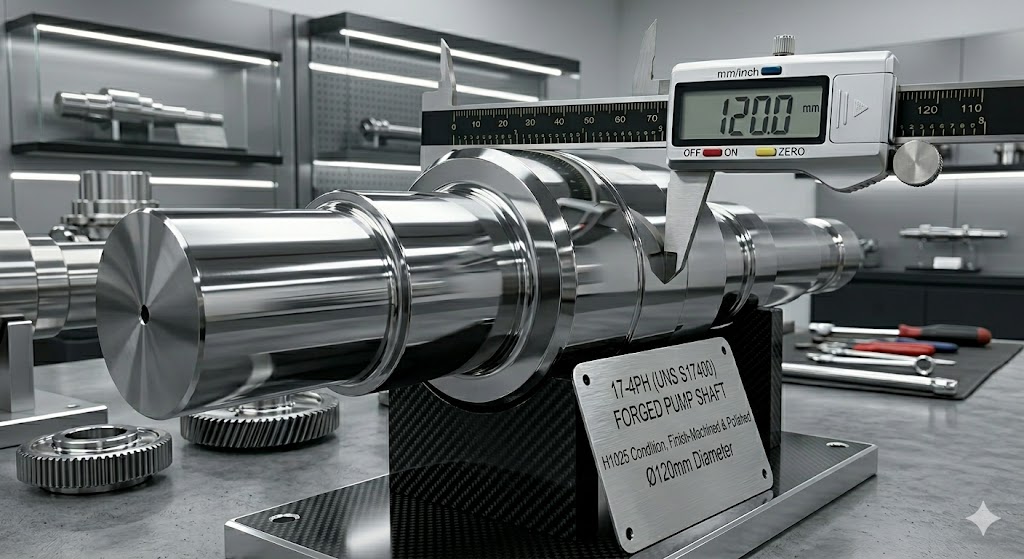
Forged Pump Shaft
H1025 condition, rough-machined Ø120 mm, for centrifugal pump service.
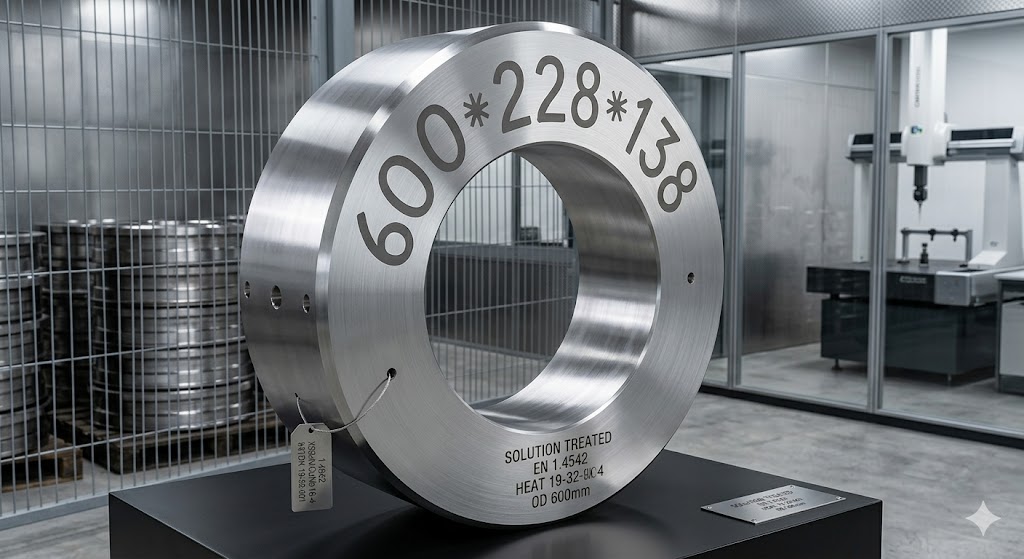
17-4PH · UNS S17400Seamless Rolled Ring
Solution-treated, OD 600 mm × wall 80 mm. Common for offshore flanges and pressure housings.
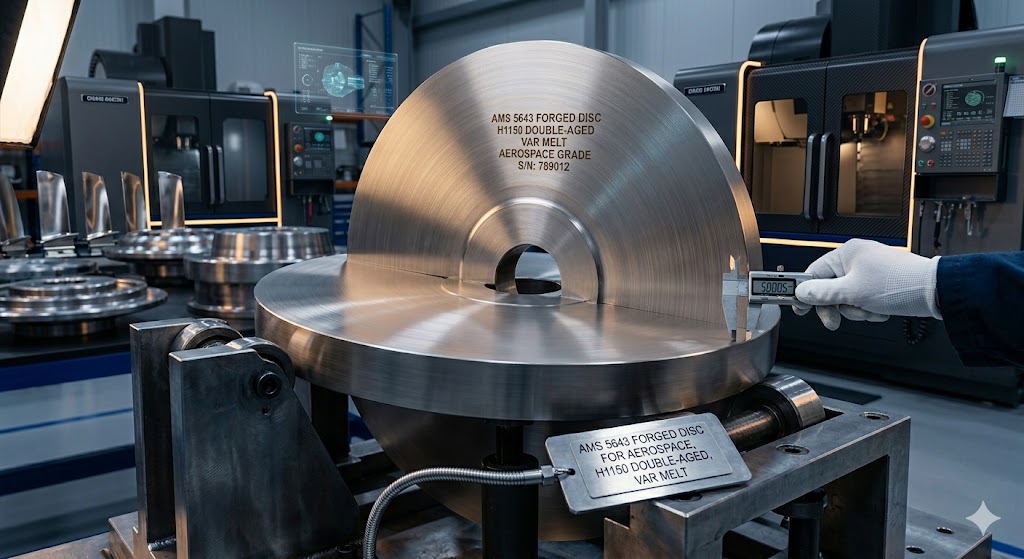
EN 1.4542 · X5CrNiCuNb16-4Disc Forging (AMS 5643 chemistry)
H1150 double-aged, transverse tensile tested per AMS 5643. Customer-witnessed release on request.
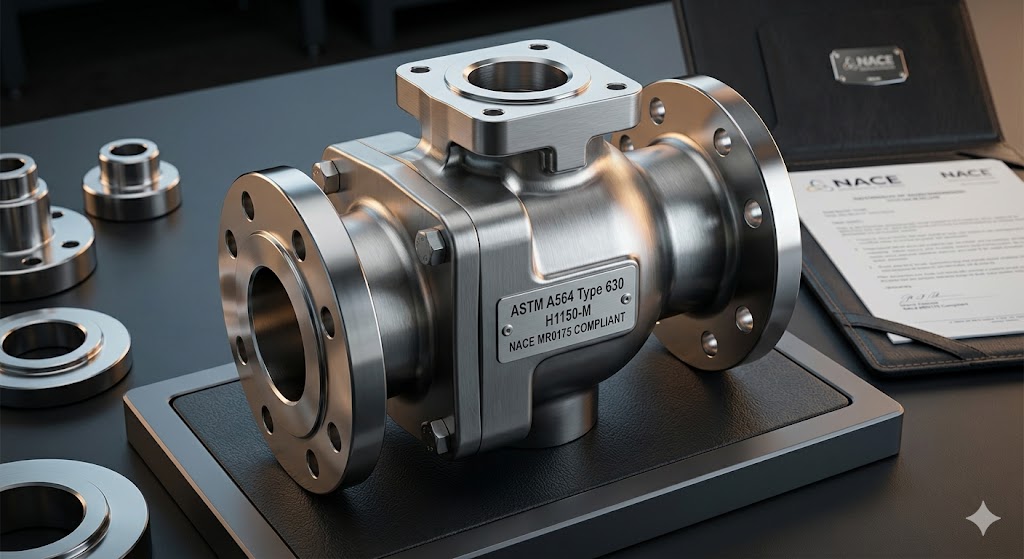
AMS 5643Forged Valve Body
H1150-M double-aged, hardness ≤ 33 HRC, for sour service per NACE MR0175 / ISO 15156.
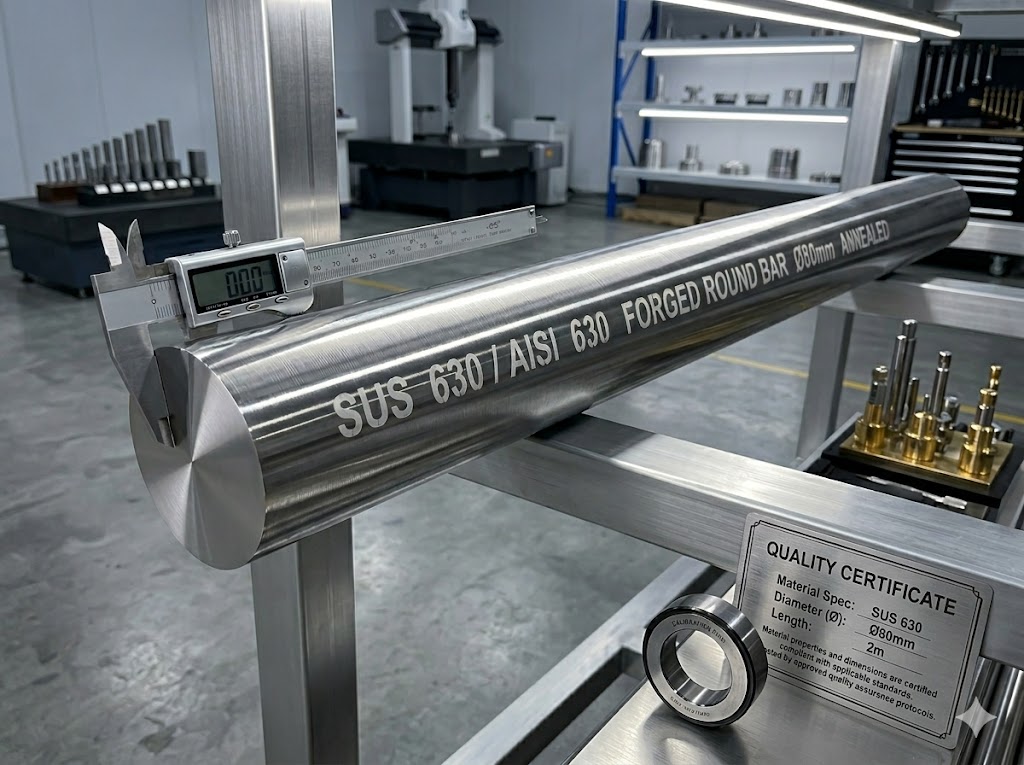
ASTM A564 Type 630Forged Round Bar
Annealed Condition A, Ø80 mm × 3 m. Cut-to-length stock for machining shops.
SUS 630 · AISI 630
17-4PH Development Timeline — From Invention to Industry Workhorse
The 17-4PH alloy has a 75-year industrial history. Understanding its evolution helps procurement engineers appreciate why certain specifications (especially aerospace AMS 5643 and NACE H1150-M) exist as they do today.
1947
Armco (USA) invents 17-4 PH®
Armco Steel Corporation develops the first precipitation-hardening martensitic stainless steel. The breakthrough: ~4% copper added to a 17%Cr–4%Ni matrix produces strengthening ε-Cu precipitates during low-temperature aging — strength of alloy steel with stainless corrosion resistance. Trademark 17-4 PH® is registered.
1950s
First aerospace adoption
Boeing and Douglas adopt 17-4PH for airframe fittings and hydraulic components. AMS 5643 specification is developed for aerospace bars and forgings, adding transverse tests and vacuum-melt requirements above the general ASTM A564.
1960s
UNS S17400 codified; ASTM A564 published
The Unified Numbering System assigns S17400 to the 17-4PH chemistry. ASTM A564 Type 630 becomes the generic specification — separating the alloy from the Armco trademark and allowing licensed and independent production.
1961
15-5 PH® developed
A cleaner version of 17-4PH (lower delta-ferrite content via slightly different Cr/Ni balance) is introduced as 15-5 PH for applications needing better transverse toughness — primarily heavy aerospace forgings.
1970s
PH 13-8 Mo introduced for landing gear
Armco develops PH 13-8 Mo (UNS S13800) — premium PH stainless with Mo addition for higher strength + better corrosion. Reserved for critical aerospace where 17-4PH lacks toughness or quality. 17-4PH remains the general industrial workhorse.
1980s
EN 10088-3 / DIN 1.4542 standardized in Europe
European Committee for Standardization adopts the 17-4PH chemistry as 1.4542 (X5CrNiCuNb16-4) with tighter sulfur (≤0.015%) and silicon limits — driven by European demand for cleaner stainless for offshore and nuclear projects.
1990s
NACE MR0175 restricts 17-4PH to H1150-M for sour service
After multiple sulfide-stress-cracking failures in oil & gas, NACE MR0175 (later ISO 15156) restricts 17-4PH in H₂S-containing environments to the double-aged H1150-M condition with hardness ≤33 HRC. This becomes the dominant H-condition for oilfield wellhead and downhole components.
2007
Armco → AK Steel → Cleveland-Cliffs
After multiple corporate restructurings, the 17-4 PH®, 15-5 PH®, and PH 13-8 Mo® trademarks transfer to AK Steel, then to Cleveland-Cliffs Inc. in 2020. Generic equivalents (UNS S17400, ASTM A564) remain unrestricted for independent producers.
2020s
Additive manufacturing & sustainable forging
17-4PH becomes one of the most widely used metals in laser powder-bed-fusion (L-PBF) and binder-jet 3D printing. Concurrently, traditional forging producers shift to scrap-based EAF + secondary metallurgy with lower embodied carbon — addressing aerospace and OEM ESG requirements.
What Is 17-4PH / UNS S17400 Stainless Steel?
17-4PH (AISI 630 / UNS S17400 / ASTM A564 Type 630 / AMS 5643 / DIN 1.4542 / SUS 630) is the
most widely used precipitation-hardening martensitic stainless steel. Its nominal
composition — 17%Cr, 4%Ni, 3–5%Cu, with niobium / tantalum stabilizer — produces a
martensitic microstructure on cooling from solution treatment, which is then strengthened
by a final low-temperature aging step that precipitates copper-rich (ε-Cu) particles
throughout the matrix. The result is a stainless steel with strength competitive with
medium-carbon alloy steels (up to 1,310 MPa UTS / 190 ksi) while retaining good corrosion
resistance similar to Type 304.
The defining feature of 17-4PH is the tunable strength-vs-toughness trade-off
available through choice of aging temperature. The H-number (e.g. H900, H1025, H1150)
denotes the aging temperature in °F. Higher aging temperatures produce lower strength but
higher impact toughness, better stress-corrosion cracking resistance, and improved
ductility. This single-grade flexibility is why 17-4PH dominates pump and valve industries
(which need high strength + corrosion resistance), aerospace structural parts, marine
hardware, food and chemical processing equipment, and many specialty industrial
applications.
17-4PH is martensitic and therefore magnetic in all conditions
(μᵣ ≈ 95 typical) — distinguishing it from the austenitic Cr-Ni stainless grades. It should
not be used for prolonged service above ~315 °C (600 °F), since aging-temperature exposure
will over-age the precipitates and reduce strength. For higher service temperatures, see
our A286
/ UNS S66286 page.
What Is the EN 1.4542 / SUS 630 / AMS 5643 Equivalent of 17-4PH?
17-4PH is sold under multiple designations depending on the specifying body. Engineers
searching for any of the following names below the trademark line are referring to the
identical chemistry, and Jiangyin Jiangnan Metal Co., Ltd. accepts
purchase orders under all of them — supplying UNS S17400 / ASTM A564 Type 630 forgings
that meet the equivalent specifications:
Table 0 — 17-4PH / UNS S17400 Equivalent Designations
Standard / Body
Designation
Region / Notes
USA · Brand (Cleveland-Cliffs trademark)
17-4 PH®
Registered trademark of Cleveland-Cliffs Inc. We do not sell under this name; we ship the generic equivalents below.
USA · UNS
UNS S17400
Generic Unified Numbering System designation
USA · AISI (legacy)
AISI 630
Legacy American Iron and Steel Institute designation — still widely used on drawings and datasheets
USA · ASTM (bars/forgings)
ASTM A564 Type 630
Hot-rolled and cold-finished bars / shapes
USA · ASTM (sheet/plate)
ASTM A693 Type 630
Sheet, strip, plate
USA · ASTM (forgings)
ASTM A705 Gr 630
Forging-specific spec
USA · AMS (bars/forgings)
AMS 5643
Bars, forgings, tubing, rings — most common aerospace spec
USA · AMS (sheet/strip)
AMS 5604
Sheet and strip
USA · AMS (alternate bars)
AMS 5622
Bars, alternate spec
USA · ASME BPVC
SA-564 Type 630 / SA-705 Gr 630
Pressure vessel code equivalents
EU · DIN / EN
1.4542 / X5CrNiCuNb16-4
European designation per EN 10088-3
Japan · JIS
SUS 630
JIS G 4303 / G 4318
What Is the Chemical Composition of 17-4PH / UNS S17400?
The 17-4PH chemistry below is per ASTM A564 Type 630 / A705 Grade 630, and
is essentially identical across AMS 5643, AMS 5604, AMS 5622, and DIN 1.4542. The chromium
provides corrosion resistance; the low nickel + copper stabilizes martensite with
precipitation-strengthening capability; the niobium + tantalum addition prevents
chromium-carbide sensitization and aids precipitation control during aging.
Table 1 — 17-4PH / UNS S17400 Chemical Composition (wt %, ASTM A564 Type 630)
Element
Min
Max
Role
Carbon (C)
—
0.07
Strength contribution; capped low to maintain corrosion resistance
Manganese (Mn)
—
1.00
Deoxidizer
Silicon (Si)
—
1.00
Deoxidizer
Phosphorus (P)
—
0.040
Impurity
Sulfur (S)
—
0.030
Impurity
Chromium (Cr)
15.00
17.50
Corrosion resistance, martensite stabilizer
Nickel (Ni)
3.00
5.00
Toughness, martensite-finish temperature control
Copper (Cu)
3.00
5.00
Primary precipitation-hardening element (ε-Cu phase)
Niobium + Tantalum (Nb+Ta)
0.15
0.45
Stabilizer; precipitation control during aging
Iron (Fe)
Balance
Matrix
How Do ASTM A564, AMS 5643, EN 1.4542, and SUS 630 Differ?
The table above shows the ASTM A564 Type 630 chemistry — the most common reference for 17-4PH. However, EN 1.4542, JIS SUS 630, and AMS 5643 have subtle but real differences in element limits and test requirements. Most competitor pages claim these are identical; technically they're not. Jiangyin Jiangnan Metal Co., Ltd. produces material to the most restrictive limits where required, so a single heat can satisfy multiple specifications simultaneously on the MTC.
Chemistry Limits — Side-by-Side
Table 1b — Chemistry limits by standard (wt %, all values are max unless range shown)
Element
ASTM A564 Type 630 (USA)
AMS 5643 (USA aerospace)
EN 1.4542 (Europe)
JIS SUS 630 (Japan)
Carbon (C)
0.07
0.07
0.07
0.07
Silicon (Si)
1.00
1.00
0.70
1.00
Manganese (Mn)
1.00
1.00
1.50
1.00
Phosphorus (P)
0.040
0.040
0.040
0.040
Sulfur (S)
0.030
0.030 (often ≤0.015 by spec)
0.015
0.030
Chromium (Cr)
15.00–17.50
15.00–17.50
15.00–17.00
15.00–17.50
Nickel (Ni)
3.00–5.00
3.00–5.00
3.00–5.00
3.00–5.00
Copper (Cu)
3.00–5.00
3.00–5.00
3.00–5.00
3.00–5.00
Niobium + Ta (Nb+Ta)
0.15–0.45
0.15–0.45
≤0.45 (no min)
0.15–0.45
Molybdenum (Mo)
not specified
not specified
≤0.60 (allowed)
not specified
Nitrogen (N)
not specified
not specified
not specified, but typically ≤0.05
not specified
Tighter than ASTM (cleaner steel required) Looser than ASTM Element allowed/specified that ASTM doesn't
Bottom line on chemistry: a single 17-4PH heat that meets EN 1.4542 (the most restrictive on S and Si) will automatically satisfy ASTM A564, AMS 5643, and JIS SUS 630 simultaneously — except for the EN-allowed Mo, which is a non-issue if Mo content is verified low. Our standard practice is to procure raw stock to the strictest applicable limit and issue a multi-designation MTC.
Mechanical Test & Quality Requirements — Side-by-Side
Minimum mechanical properties (UTS, YS, elongation, RA, hardness) are essentially identical across all four standards for the same H-condition. The real differences lie in which tests are required, in which direction, and what NDE is performed.
Table 2c — Test requirements by standard (typical)
Test / Requirement
ASTM A564 (general bars)
AMS 5643 (aerospace)
EN 10088-3 (EU bars)
JIS G 4303 (JP bars)
Tensile (longitudinal)
Required
Required
Required
Required
Tensile (transverse)
Not required
Required (cleaner ratio)
Optional
Optional
Hardness (HRC / HB)
Required per condition
Required per condition
Required in HB (Brinell)
Required HRC
Charpy impact
Optional (per buyer)
Required, tight limits
Optional
Optional
Grain flow / macroetch
Optional
Required for forgings
Optional
Optional
Vacuum / clean melt
Not required
Required (VIM/VAR or AOD)
Not required
Not required
UT (ultrasonic) NDT
Per ASTM A388
Per AMS-STD-2154 Class A
Per EN 10228
Per JIS G 0801
PT / MT surface NDT
Per ASTM E165 / E1417
Per ASTM E1417 Type I Method C, Sens Level 3+
Per EN ISO 3452
Per JIS Z 2343
Inclusion rating
Per ASTM E45 (if ordered)
Per AMS 2301 / 2304
Per ISO 4967
Per JIS G 0555
Heat-treat traceability
Heat number only
Lot-level chart recordings
Heat + cast number
Heat + cast number
Cert format
EN 10204 3.1 typical
EN 10204 3.1 or 3.2 + AMS source approval
EN 10204 3.1 / 3.2
Mill test report
Which Standard Should You Specify?
🇺🇸 US general industrial
ASTM A564 Type 630 (or A705 Gr 630 for forgings)
Pumps, valves, non-aerospace structural. Standard 3.1 mill cert. Most economical and most common.
✈ US aerospace
AMS 5643
Required for FAA / military airframes, landing-gear class, engine accessory. Cleaner chemistry, transverse tests, source-approval flow-down.
🇪🇺 European projects
EN 10088-3 1.4542 / X5CrNiCuNb16-4
EU offshore, oil & gas, nuclear, chemical plant. CE-marked projects. Tighter on S and Si than ASTM — cleaner microstructure.
🇯🇵 Japanese projects
JIS SUS 630 (per JIS G 4303 / G 4318)
Japanese OEM supply chain (auto, machinery, marine). Chemistry essentially identical to ASTM; cert format is the differentiator.
🛢 Sour service (any region)
NACE MR0175 / ISO 15156 + underlying spec
Oil & gas in H₂S. Restricts 17-4PH to H1150-M double-aged, ≤33 HRC. Add to the base spec — see the NACE checker tool above.
Multi-Standard MTC — What Jiangyin Jiangnan Metal Provides
For customers who need cross-border traceability, we supply single-heat material certified to multiple standards simultaneously. The MTC (Material Test Certificate) lists:
Primary specification ordered (e.g., AMS 5643, EN 1.4542, ASTM A564)
All equivalent designations the chemistry & mechanicals also satisfy (e.g., "Also conforms to: UNS S17400, ASTM A705 Gr 630, JIS SUS 630")
Heat-treatment chart recordings (lot-level for AMS, batch-level for general)
EN 10204 3.1 standard, or 3.2 with third-party witness (Lloyd's, DNV, BV, ABS, TÜV) on request
Practical takeaway: If you don't know which standard to specify, ASTM A564 Type 630 (for bars) or ASTM A705 Gr 630 (for forgings) is the safest default. We will cross-certify to EN 1.4542 and JIS SUS 630 on the same MTC at no extra cost. AMS 5643 aerospace certification is a separately priced lot due to the additional testing burden.
What Are the Mechanical Properties of 17-4PH in All H-Conditions?
17-4PH mechanical properties depend strongly on the aging condition. The H-number is the
aging temperature in °F. The table below summarizes minimum properties per ASTM A564 / A705
for all standard H-conditions, plus Condition A (solution annealed only). Values are for
longitudinal tests on bars / forgings up to 75 mm thick; thicker sections may show
slightly reduced properties.
Table 2 — 17-4PH / UNS S17400 Minimum Mechanical Properties by Aging Condition
Condition
Aging Temp
UTS Min
YS Min (0.2%)
El. Min %
RA Min %
Hardness
H900
482 °C (900 °F)
1,310 MPa (190 ksi)
1,170 MPa (170 ksi)
10
40
~40 HRC
H925
496 °C (925 °F)
1,170 MPa (170 ksi)
1,070 MPa (155 ksi)
10
44
~38 HRC
H1025
552 °C (1025 °F)
1,070 MPa (155 ksi)
1,000 MPa (145 ksi)
12
45
~35 HRC
H1075
580 °C (1075 °F)
1,000 MPa (145 ksi)
860 MPa (125 ksi)
13
45
~32 HRC
H1100
593 °C (1100 °F)
965 MPa (140 ksi)
795 MPa (115 ksi)
14
45
~31 HRC
H1150
621 °C (1150 °F)
930 MPa (135 ksi)
725 MPa (105 ksi)
16
50
~28 HRC
H1150-M (double-aged)
760 °C/2h + 621 °C/4h
795 MPa (115 ksi)
515 MPa (75 ksi)
18
55
~24 HRC
Condition A (sol only)
—
1,030 MPa (150 ksi)
760 MPa (110 ksi)
5
—
≤38 HRC
How Do You Choose Between 17-4PH H900, H1025, H1075, and H1150?
Choosing the correct aging condition is the most important specification decision for any
17-4PH forging order. The table below summarizes typical applications and trade-offs.
Table 2b — How to Pick the Right H-Condition
Condition
Choose this when…
Avoid this if…
Typical Industries
H900
Maximum strength / hardness needed; static loading
Impact, fatigue, or chloride SCC are concerns
Tooling, fasteners, knives
H925
Slight toughness improvement vs H900
Less common — usually H900 or H1025 is chosen
Aerospace, fasteners
H1025
Best general-purpose balance of strength and toughness
Severe chloride SCC environment present
Aerospace structural, valve bodies, general industrial
H1075
Pump shafts where fatigue and corrosion fatigue matter
Very high static loading required (use H900/H1025)
Pump industry (chemical, water)
H1100
Larger sections needing through-aging consistency
Highest yield strength is required
Heavy industrial, oil & gas
H1150
Best impact toughness and chloride SCC resistance
High-stress applications above ~700 MPa YS need a higher condition
Marine, chemical, severe service
H1150-M (double-aged)
Maximum impact toughness; severe-service downhole
Strength is the primary criterion
Oil & gas downhole, NACE applications
🎯
H-Condition Decision Wizard
Answer 4 short questions and we'll recommend the optimal H-condition for your 17-4PH part — with full reasoning.
Exclusive
1 / 4 — What is the primary application?
2 / 4 — Which property is most critical?
3 / 4 — What is the service environment?
4 / 4 — What quality / certification applies?
✅ Recommended H-Condition
Aging cycle reminder: aging is performed AFTER solution treatment (1040 °C
+ air cool to room temperature) and AFTER all rough machining. Aging dimensional change
is typically <0.1% but may need to be allowed for in critical-dimension parts.
🔥
17-4PH Heat Treatment Recipe Generator
Pick a target H-condition (or required UTS) → get a complete, printable solution + aging recipe ready for your heat-treatment vendor.
Exclusive
Recipes follow ASTM A564 / AMS 2759/3 standard cycles. Hold times scale linearly with section thickness above 25 mm (~30 min per inch / 12 mm). Vacuum or inert atmosphere preferred; ensure complete austenitization on heating and full martensite transformation before aging. Final mechanical properties guaranteed by hardness check ± tensile test on coupons.
📈
17-4PH Aging Temperature → Mechanical Properties (Interactive)
Drag the slider to see how aging temperature changes UTS, YS, hardness, and impact toughness. Watch the trade-off live.
Exclusive
482 °C (H900 — max strength)621 °C (H1150 — max toughness)
UTS
1070MPa
Yield (0.2%)
1000MPa
Hardness
35HRC
Charpy V (RT)
45J
SCC Risk
Moderate
Best Use
General service
Curves based on typical 17-4PH / UNS S17400 data per ASTM A564 / A705 and AMS 5643. Properties are minimum guaranteed values for bars/forgings ≤75 mm thickness; thicker sections may show ~5–8% reduction. Hardness and Charpy curves scaled to fit (legend shows multipliers).
🔬
17-4PH Microstructure Visualizer — Watch Precipitates Form
See how the Cu-rich ε precipitates evolve from solution-treated (Condition A) through all H-conditions. The size and density of these precipitates is what gives 17-4PH its strength.
Exclusive
1,000× magnification
Schematic only
Precipitate Size
7 nm
Density
High
Hardness
33 HRC
UTS
1070 MPa
What you're seeing: Hover over the visualization. Red dots are the Cu-rich ε precipitates (~7 nm). The yellow-brown background is the martensite matrix with parallel "lath" patterns (the basic high-strength structure formed during the solution treatment + quench). In H1025, precipitates are coherent with the matrix — they block dislocation motion efficiently, giving the best strength-toughness balance. Use the dropdown above to see how the microstructure changes with H-condition.
Schematic illustration only — real microstructure precipitate sizes range 1-50 nm and are only visible under transmission electron microscopy (TEM). Sizes shown are exaggerated for visibility. Based on published data: Habibi Bajguirani (2002) for 15-5PH; Hochanadel et al. (1994) for PH 13-8 Mo (similar precipitation behavior to 17-4PH).
Choose your aging temperature and time — see the predicted strength evolution curve. Useful for: planning custom heat treatments, predicting effect of accidental over-aging, comparing time-temperature trade-offs.
Exclusive
552 °C
4.0 h
Current UTS
1200 MPa
Peak UTS at this Temp
1230 MPa
Time to Peak
3.0 h
% from Peak
-2%
Status:Approaching peak strength — typical commercial aging window. Small variations in time will have little effect on properties.
Model based on published 17-4PH aging kinetics (Cu precipitation + coarsening). Real properties depend on prior solution treatment quality, section thickness, and material chemistry within the spec band. The curve uses an Avrami-type rise + Ostwald-ripening coarsening model fit to ASTM A564 nominal property tables. For production heat treatment, always validate with hardness tests on test coupons from the same heat.
〰️
17-4PH Fatigue S-N Curve Interactive
Pick H-condition and stress amplitude — see predicted cycles to failure. Rotating-bending data, R = −1, smooth specimen, room temperature.
Exclusive
300600 MPa900
0 = fully reversed (R=−1)
Selected stress
600MPa amplitude
Predicted life
2.5 × 10⁵cycles
Service hours @ 30 Hz
2.3hours
Endurance limit (10⁷)
590MPa
Verdict
Finite life
Goodman mean correction
No
S-N curves based on typical published 17-4PH rotating-bending fatigue data (R = −1, smooth specimen, RT). Real fatigue life depends strongly on surface finish (multiply by 0.6–0.8 for as-machined, 0.4–0.6 for as-forged), notch geometry (Kf factor), corrosive environment, and mean stress. Goodman-corrected fatigue limit shown when mean stress > 0. For design, apply factor of safety ≥ 2 on stress or 10 on cycles.
Design Calculation Worked Examples — 17-4PH in Service
The following three worked examples demonstrate how 17-4PH mechanical data feeds into real engineering decisions. They are simplified for clarity; production designs require finite-element verification and applicable code factors.
Example 1 — Centrifugal Pump Shaft Critical Speed
A vertical centrifugal pump shaft, 17-4PH H1075, must be checked against its first lateral critical speed.
Given
Shaft diameter D = 150 mm; bearing span L = 2,000 mm; impeller mass m = 80 kg (mid-span); operating speed Nop = 1,800 RPM. Material: 17-4PH H1075 (E = 196 GPa, ρ = 7.75 g/cm³).
Formula (Rayleigh / Dunkerley)
First critical speed for a shaft with concentrated mass mid-span between simple supports: Nc = (60 / 2π) × √(48EI / (mL³)) where I = πD⁴/64.
Verdict
Operating speed 1,800 RPM is ~31% of critical → safe. Industry rule: keep Nop < 0.7 × Nc. Use H1075 (good fatigue), or H1025 if higher rigidity is needed (UTS gain ~7%). Don't use H900 — fatigue resistance is worse despite higher yield.
Example 2 — Valve Stem Buckling (Euler)
A high-pressure valve stem, 17-4PH H1025, must resist axial compression from seat seating force without buckling.
Given
Stem diameter d = 25 mm; unsupported length Le = 600 mm (fixed-pinned, effective length factor K = 0.7); applied axial force F = 50 kN.
Verdict
Safety factor 0.78 < 1.0 → finite life only, infinite life NOT achieved. Action options: (1) reduce stress amplitude (e.g. increase cross-section by 15-20%), (2) upgrade to H900 if static-strength budget allows (Se ≈ 620 MPa raw), (3) improve surface (shot-peen → Cs = 1.1) which would push n above 1.0 with no design change. Most economical fix: shot-peen + size up 10%.
These worked examples are simplified educational examples. Actual production designs must consider: temperature derating, multi-axial stress, environmental factors (corrosion fatigue, hydrogen), code-specified safety factors (ASME, API, EN 13445), and lifecycle vs operating cost trade-offs. Contact our engineering team for project-specific consultation.
What Are the Physical Properties of 17-4PH (Density, Thermal, Magnetic)?
How Corrosion-Resistant Is 17-4PH in Seawater, Acids, and Sour Service?
17-4PH offers corrosion resistance roughly comparable to Type 304 in most
environments — better than carbon and low-alloy steels, but inferior to Type 316L (which
contains 2–3% Mo). The PREN of 17-4PH is approximately 17, well below the threshold for
chloride pitting in seawater, which is why marine 17-4PH applications are typically limited
to splash zones and short-term immersion rather than continuous full immersion.
The H-condition affects corrosion behavior. Lower-temperature aging (H900) produces highest
strength but increases susceptibility to chloride stress-corrosion cracking (SCC) in
high-chloride environments. Higher-temperature aging (H1100, H1150) reduces strength but
significantly improves SCC resistance. For oil & gas service per NACE MR0175 / ISO
15156, 17-4PH is typically restricted to H1150-M double-aged condition with hardness
≤33 HRC.
🛢️
NACE MR0175 / ISO 15156 Sour-Service Compliance Checker
Enter your service conditions — get instant feedback on whether 17-4PH at your spec passes NACE sour-service requirements.
Exclusive
Threshold for sour: ≥0.3 kPa (0.05 psi)
Disclaimer: This is a first-pass screening tool based on NACE MR0175 / ISO 15156-3 Table A.20 (17-4PH PH stainless). Final material acceptance requires review by a qualified materials engineer and may involve project-specific testing per the most current edition of the standard. Jiangyin Jiangnan Metal Co., Ltd. provides this tool for guidance and is not liable for application decisions.
🌡️
17-4PH Service Temperature Safety Assessment
Enter your service temperature and expected duration — get safety verdict, predicted strength retention, and alternative material suggestions if 17-4PH is unsafe.
Exclusive
0 °C200 °C315 °C700 °C
0–200 °CSafe — full strength retained, no over-aging risk for any service duration
200–315 °CCaution — long-term (>10,000 h) may cause modest strength loss
> 315 °CNot recommended — switch to A286, Inconel 718, or 17-7PH
17-4PH service-temperature limits are governed by precipitation over-aging kinetics. Aging temperatures of 480–620 °C are the precipitation regime — any service temperature approaching the aging temperature will progressively soften the part. Conservative continuous-service limit is ~315 °C (600 °F). For higher temperatures, consider A286 / UNS S66286 (~700 °C) or Inconel 718 (~650 °C).
For severe chloride or aggressive acid environments, consider upgrading to:
PH 13-8 Mo (UNS S13800) — premium aerospace PH grade with Mo addition for better corrosion and toughness
The following failure modes are the most commonly observed root causes in 17-4PH service failures we and customers have reviewed over the past decade. Knowing them lets you specify the right H-condition, NDE, and service envelope upfront — avoiding costly in-service recalls.
💥
Chloride Stress Corrosion Cracking (Cl-SCC)
Root cause
High-strength H-conditions (H900/H925) in chloride environments + tensile residual stress. Cracks initiate at surface pits, propagate transgranularly.
Detection
Surface PT/MT shows linear surface cracks; UT may show subsurface branched cracks. Often catastrophic before detection.
Prevention
Use H1100 or H1150 in any chloride exposure. For seawater, upgrade to 2205 duplex or super-duplex.
⚠️
Sulfide Stress Cracking (SSC) — NACE
Root cause
H₂S service with hardness above 33 HRC. Atomic hydrogen from H₂S dissociation enters the lattice, embrittles martensite, cracking under tensile load.
Mandatory H1150-M double-aged condition. Hardness ≤33 HRC verified at every region. NACE MR0175 / ISO 15156 compliance.
🌡️
Service Over-aging (Strength Loss)
Root cause
Service temperature above ~315 °C. Cu-rich ε precipitates coarsen, lose coherency, mechanical strength drops 15-40% over months.
Detection
Hardness drop from ~33 HRC to ≤25 HRC. Increased ductility but lower yield strength. Possible plastic deformation under design loads.
Prevention
Do not use 17-4PH above 315 °C continuous. Use the Service Temp Assessment tool. Upgrade to A286 or Inconel 718 for higher temps.
⚗️
Sigma Phase Embrittlement
Root cause
Extended exposure to 565-870 °C (e.g. slow cooling from high-temperature service, improper post-weld heat treatment). Brittle Fe-Cr sigma phase precipitates at grain boundaries.
Detection
Charpy impact toughness drops dramatically (≥50% reduction). Often discovered only post-fracture by metallography.
Prevention
Quench rapidly through 565-870 °C range. After welding, full solution + re-age. Avoid intermediate-temperature soaking.
🔋
Galvanic Corrosion
Root cause
17-4PH coupled with more noble alloys (e.g. Inconel, Hastelloy, copper alloys) in electrolyte. 17-4PH becomes anode, accelerated localized corrosion.
Detection
Pitting and crevice corrosion at the junction. Asymmetric corrosion pattern — only one side affected.
Prevention
Isolate dissimilar metals with insulating sleeves/gaskets. Use cathodic protection or sacrificial anodes. Avoid coupling 17-4PH with copper-based alloys in seawater.
💧
Pitting Corrosion (Chloride)
Root cause
17-4PH PREN ≈17 — below threshold for chloride pit-free service in seawater. Pits initiate at MnS inclusions or surface defects, deepen autocatalytically.
Detection
Localized deep pits (sometimes <1 mm wide but 5+ mm deep). May connect to form crack-like features.
Prevention
For chloride service, specify EN 1.4542 (lower S → fewer MnS pit initiators). Limit chloride exposure; use 316L or 2205 if continuous chloride.
🔄
High-Cycle Fatigue Failure
Root cause
Cyclic stress above endurance limit (~600 MPa for H900, ~460 MPa for H1150). Surface defects, machining marks, or notches reduce fatigue strength 30-50%.
Detection
Beach-mark fracture surface. Crack initiates at surface, propagates slowly until residual cross-section fails. Use the Fatigue S-N tool.
Prevention
Surface roughness Ra ≤1.6 µm; shot-peening or low-stress grinding. Generous radii at stress concentrations. H1075 has best fatigue balance.
⚡
Hydrogen Embrittlement
Root cause
Hydrogen introduced during pickling, electroplating, welding, or cathodic protection. Hydrogen diffuses to martensite lath boundaries → brittle delayed cracking.
Detection
Delayed cracking days to weeks after service start, usually at threads or other notches. Fracture surface shows intergranular features.
Prevention
Bake at 190-220 °C for 4-24 hours after plating/pickling. Avoid cathodic over-protection. Use H1150 or H1150-M for any plated/pickled parts.
🔥
Improper Heat Treatment
Root cause
Incomplete solution treatment (too cold or too brief), interrupted cooling (transformation not complete), or wrong aging cycle. Result: mixed retained austenite + incorrect Cu precipitate state.
Detection
Hardness out-of-spec (too high or too low). UTS does not match expected H-condition. Microstructure analysis confirms.
Prevention
Verify both solution and aging cycles in MTC. Check actual furnace charts (lot-level recording). Use HT Recipe Generator for correct parameters.
🌀
Forging Defects (Bursts, Laps)
Root cause
Forging below ~950 °C (work-hardening regime) or excessive reduction in one stroke. Internal "bursts" (cracks) or surface "laps" (folded oxide layers).
Detection
UT shows internal indications; surface PT/MT shows linear lap indications. Often hidden until final machining exposes them.
Prevention
Maintain forging temperature 1170-1230 °C; never below 950 °C. Multi-step incremental reduction. UT acceptance per ASTM A388 Class B or better.
🌊
Crevice Corrosion in Threads/Joints
Root cause
Stagnant electrolyte in crevices (threads, gaskets, lap joints) becomes acidic + chloride-rich. Local PREN drops below threshold, attack initiates.
Detection
Crevice surface shows discoloration, eventually deep pits. Often goes unnoticed until pressure-test failure.
Prevention
Design out crevices (radius corners, flush gasket seating). For chloride service, use H1150 or upgrade to duplex.
🛠️
Welding Heat-Affected Zone (HAZ) Issues
Root cause
Welding without proper preparation. HAZ may be partially solution-treated, partially over-aged. Properties uneven across joint.
Detection
Hardness scan across weld shows soft band in HAZ. May fail in HAZ rather than weld metal.
Prevention
Weld in Condition A; full solution + age after welding. Use ER630 matching filler. 150 °C preheat for thick / restrained joints.
When Should You Choose 17-4PH Over PH 13-8 Mo, 15-5 PH, or 304L?
Table 4 — 17-4PH vs Other PH and Common Stainless Grades
Property
17-4PH (H1025)
PH 13-8 Mo (H1000)
15-5 PH (H1025)
304L
316L
UNS
S17400
S13800
S15500
S30403
S31603
Type
Martensitic PH
Martensitic PH
Martensitic PH
Austenitic
Austenitic
UTS
~1,070 MPa
~1,520 MPa
~1,070 MPa
~515 MPa
~485 MPa
YS (0.2%)
~1,000 MPa
~1,410 MPa
~1,000 MPa
~205 MPa
~170 MPa
Density
7.75 g/cm³
7.78 g/cm³
7.78 g/cm³
7.99 g/cm³
7.99 g/cm³
Magnetic
Yes
Yes
Yes
No
No
PREN (approx)
17
22
17
19
26
Max service temp
~315 °C
~430 °C
~315 °C
~870 °C (low YS)
~870 °C (low YS)
Transverse toughness
Moderate
Excellent (cleaner alloy)
Better than 17-4PH
Excellent
Excellent
Relative cost
2 ×
4–5 ×
2.5 ×
1 × (baseline)
1.3 ×
Best use
General PH workhorse
Aerospace landing gear
Heavy aerospace forgings
General service
Marine / mild chloride
🔄
Material Substitution Finder — Can I Replace [X] with 17-4PH?
Pick what you're currently using → see whether 17-4PH is a valid substitute, which H-condition, what you gain, and what to watch for.
Exclusive
Substitution analysis based on published typical properties — see individual material datasheets for verified values. Final substitution decisions should be made by a qualified materials engineer considering application-specific factors (cyclic loading, environment, certification, weldability, joinability, supply chain).
💰
Cost-per-Strength Comparison — 17-4PH vs Alternatives
Pick part weight + quantity → see total cost across 17-4PH and 5 alternatives, ranked by cost-per-MPa value. Find when 17-4PH is the right economic choice.
Exclusive
Cost Comparison Results
How to read this:
Price Index Transparency: 17-4PH raw material cost is dominated by nickel (3-5%), chromium (15-17.5%), copper (3-5%), and niobium content. Mill prices track the LME nickel and ferro-chrome indices with a typical 2-4 week lag. We do not publish absolute prices on the website (they change weekly and depend on quantity, dimensions, certification level, and lead time), but we offer transparent index-linked pricing in long-term supply agreements. Contact us for current spot price ranges. Reference prices used by the comparison calculator above are indicative average mill prices for hot-forged round bars in standard sizes, FOB China, Q2 2026. Actual quoted prices depend on quantity, dimensions, certification level, lead time, and supply-chain factors. Cost-per-MPa metric uses minimum yield strength of each material's standard production condition (17-4PH H1025, 15-5PH H1025, PH 13-8 Mo H1000, 4340 Q&T, 316L annealed, A286 STA). Forging conversion, machining, and finishing costs are separate.
How Do You Weld, Machine, and Forge 17-4PH / UNS S17400?
Welding
17-4PH is one of the most weldable PH stainless steels. GTAW (TIG) and GMAW (MIG) are the
most common processes; matching filler wire (per AMS 5825 / 5826) is preferred; ER630 is the
generic equivalent. Welding should be performed in Condition A (solution
annealed); after welding, perform a full solution treatment + age to recover properties in
and around the weld zone. Preheating is generally not required for thin sections; thick or
highly restrained joints may benefit from 150 °C preheat to reduce hydrogen-cracking risk.
Machining
Machinability of 17-4PH is approximately 50% of free-machining 416 stainless
and somewhat better than 304/316L. Machining in Condition A (~33 HRC) is preferred — the
alloy work-hardens less than austenitic grades. Use sharp, rigid carbide tooling, positive
rake geometry, moderate cutting speeds (~50–80 m/min for turning), heavy positive feeds, and
generous coolant. After final machining, age to the required H-condition. Aging dimensional
change is typically <0.1% (slight contraction) but may matter for tight-tolerance parts.
Forging
17-4PH / UNS S17400 forges within a 1170–1230 °C window, with a finishing
temperature above 950 °C to avoid the δ-ferrite range. Forging ratio should be ≥4:1 to break
down the as-cast structure and meet AMS 5643 grain-flow requirements. The grade is well
suited to all common forging routes — open-die forging for shafts and discs, hot ring rolling
for seamless rings, closed-die forging for repeat-volume small parts, and upset forging for
short, large-section blanks. Near-net-shape forging is practical on geometries where 30–50%
of the rough machining can be eliminated by the die profile; this is typical for compressor
impeller hubs and valve-body bodies. Slow furnace cooling after the final blow is essential
— air or water quench from forging temperature can leave residual ferrite stringers visible
on macroetch and may fail AMS 5643 micro-cleanliness checks. For long bored shafts above
~Ø 100 mm bore, ordering a trepanned billet rather than a solid bar reduces material input
by 40–60% and shortens drilling time on the finished part.
🔧
17-4PH Machinability Parameter Calculator
Pick H-condition + operation + tool material → get recommended cutting speed, feed, depth-of-cut, and expected tool life. Saves machining engineers an afternoon of handbook lookups.
Exclusive
✓ Recommended starting parameters
Cutting Speed (Vc)
75m/min
Surface Speed (SFM)
246ft/min
Feed Rate (f)
0.20mm/rev
Depth of Cut (ap)
2.0mm
Expected Tool Life
25min
Recommended Coolant
Flood, 8% emulsion
Parameters are starting values; final selection depends on machine rigidity, setup stiffness, tool holder geometry, and surface-finish requirements. 17-4PH work-hardens — maintain positive feed contact; never dwell. Coolant strongly recommended for all operations. For deep drilling, peck-cycle programming reduces chip-clogging and tool-life loss. Best surface finish at high-speed light-feed; best material removal rate at moderate-speed heavy-feed.
Forging
17-4PH forging temperature range is 1170–1230 °C (2150–2250 °F). Do not
forge below ~950 °C (~1750 °F) — the alloy work-hardens rapidly and cracking risk increases
substantially. After forging, slow-cool (preferably furnace cool) to room temperature, then
solution treat (1040 °C + air cool) and age to the desired H-condition. Heavy forgings may
require intermediate stress-relief between forging operations.
Production Capability — 17-4PH / UNS S17400 Forging Manufacturer
As one of the most-requested grades in our portfolio, 17-4PH represents a high-volume
production grade at Jiangyin Jiangnan Metal Co., Ltd. Our maximum forging envelopes for
UNS S17400 reflect the alloy's good forgeability (better than most superalloys) and
standard PH stainless heat-treatment cycles.
Complete 17-4PH Forging Process Flow
From raw material to finished MTC, every 17-4PH forging at Jiangyin Jiangnan Metal passes through these 8 controlled stages. Each step is logged on the heat-treatment chart and traceable on the final certificate.
1
🔥
Raw Material
VAR / VIM bar billet Heat number traced Chemistry verified
2
🔨
Forging
1170–1230 °C Forging ratio ≥4:1 Multi-step reduction
3
❄️
Slow Cool
Furnace cool 0.5 °C/min Avoid 565–870 °C dwell
4
⚙️
Rough Machine
±2 mm finish stock Condition A best HSS UT after
5
🌡️
Solution Treat
1040 °C ± 10 °C 30 min / inch Air cool to <30 °C
6
⏱️
Aging (H-Cond)
H1025 = 552 °C / 4 h H1150-M = 2-step Air cool
7
🔍
NDT & Test
UT ASTM A388 PT/MT surface Hardness + tensile
8
📋
MTC & Ship
EN 10204 3.1/3.2 Multi-standard cert Marked + packed
Production Equipment Capability
The following equipment is qualified and calibrated for 17-4PH / UNS S17400 production. Section sizes and weights given are tested limits for this specific alloy (may differ from carbon steel limits).
Forging — Heavy
Free-Die Hydraulic Press 40 MN
Max ingot: 12 tons Max diameter: 1,800 mm Max length: 8,000 mm
Forging — Medium
Free-Die Hydraulic Press 25 MN
Max ingot: 6 tons Best for shafts & bars Faster cycle than 40 MN
Ring Rolling
Radial-Axial Ring Mill
Max OD: 2,500 mm Max height: 600 mm Min wall: 30 mm
Heat Treatment
Bogie-Hearth Solution Furnace
8 × 4 × 2 m chamber 1100 °C max ±5 °C uniformity
Heat Treatment
Belt-Type Aging Furnace
Ø 2.5 m × 6 m length 200–700 °C range ±3 °C uniformity
Heat Treatment
Air-Quench Tank
Forced-air cooling Rapid cool from 1040 °C For all H-conditions
NDT — UT
Phased-Array Ultrasonic
ASTM A388 Class A/B/C AMS-STD-2154 Class A Automated scan + report
NDT — PT
Fluorescent Penetrant Line
ASTM E1417 Type I Method C, Sens 3-4 Aerospace-capable
NDT — MT
Wet Fluorescent Mag-Particle
ASTM E1444 Coil & yoke methods For surface defects
Lab — Chemistry
Optical Emission Spectrometer
Full elemental analysis Calibrated daily NIST-traceable standards
Lab — Mechanical
300 kN Universal Test Machine
Tensile per ASTM E8 Charpy V impact per E23 Hardness HRC/HB/HV
Lab — Metallography
Microstructure Lab
Up to 1000× optical Grain size per ASTM E112 Macroetch per E381
Transparent delivery data, refreshed quarterly. Based on 387 17-4PH / UNS S17400 orders shipped Q1 2025 – Q1 2026.
H1025 / H1075 standard
92% in 8 wk
H900 / H925 high-strength
88% in 9 wk
H1150 / H1150-M
86% in 10 wk
AMS 5643 aerospace cert
82% in 12 wk
Large forgings (>3 t)
78% in 14 wk
NACE 3.2-witnessed (DNV / BV / Lloyd's)
75% in 14 wk
% shown = orders shipped within the stated week count, measured from order confirmation to ex-works dispatch. For short-lead stock items (common bar sizes in Condition A), 4-6 week dispatch is possible — contact us for current stock.
Max Disc Ø
1,800 mm
Max Ring OD
2,500 mm
Max Shaft L
8 m
Max Single Weight
8,000 kg
Bar Ø Range
25–500 mm
H-Conditions
H900, H925 H1025, H1075 H1100, H1150 H1150-M
Available Forms — 17-4PH / UNS S17400
Pump shafts up to 8 m length, supplied in H1025 or H1075 condition (most common)
Pump impellers and casings (closed-die or rough-machined open-die)
Valve bodies, valve stems, valve trim per API 6A / 6D requirements
Forged discs and hubs up to 1,800 mm diameter
Seamless rolled rings up to 2,500 mm OD (rectangular, contoured, T-section)
Custom near-net-shape forgings to customer drawings
⚖️
17-4PH Forging Weight Calculator
Pick a shape and dimensions → instant weight using 17-4PH density (7.75 g/cm³). Use the result to populate your RFQ.
Exclusive
Volume
—cm³
Weight (kg)
—kg
Weight (lb)
—lb
Approx. forging billet
—
Calculation uses 17-4PH density 7.75 g/cm³ (0.280 lb/in³). Result is the net finished weight; allow +20–35% machining stock for the rough forging weight (depends on geometry and tolerance). Maximum single-piece capability at Jiangyin Jiangnan Metal Co., Ltd. is 8,000 kg.
Which Standards and Quality Systems Apply to 17-4PH Forgings?
For 17-4PH / UNS S17400 orders, the dominant specifications at Jiangyin Jiangnan Metal Co.,
Ltd. are the ASTM A564 / A693 / A705 family (general industrial / pressure
vessel use) and AMS 5643 (aerospace bars and forgings). For European
projects, DIN 1.4542 / EN 10088-3 applies. For oil & gas service, NACE MR0175 / ISO
15156 restrictions on hardness apply (typically requires H1150-M condition with hardness
≤33 HRC).
Quality Management Certification
ISO 9001:2015
Material & Inspection Standards Followed
ASTM A564 Type 630ASTM A693 Type 630ASTM A705 Gr 630AMS 5643AMS 5604AMS 5622DIN 1.4542EN 10088-3JIS SUS 630NACE MR0175*EN 10204 3.1EN 10204 3.2*
* NACE MR0175 / ISO 15156 sour-service compliance for 17-4PH typically requires the
H1150-M double-aged condition with hardness ≤33 HRC. EN 10204 3.2 third-party witness
certificates are issued through client-nominated inspection bodies (Lloyd's, DNV, BV, ABS,
TÜV) on a per-order basis.
Each 17-4PH / UNS S17400 order passes through 6 mandatory hold points where production cannot proceed without QA sign-off: (1) raw material chemistry verification, (2) forging temperature compliance, (3) post-forging UT, (4) heat treatment chart approval, (5) mechanical test result acceptance, (6) final NDE + dimensional. Customer-witnessed hold points can be added on request at no charge.
Non-Conformance Report (NCR) Handling
Any out-of-specification finding triggers a formal NCR within 24 hours. Root-cause analysis (5-Why or Fishbone) completed within 5 working days. Customer receives the NCR with proposed disposition (rework / regrade / scrap / use-as-is with concession) before any action is taken. No silent rework.
Replacement Guarantee
Material found to be non-conforming within 6 months of delivery — verified by independent third-party test — is replaced free of charge, including freight. Shipping documentation is retained for 10 years to support warranty claims.
Witness Inspection Right
Customers retain unrestricted right to witness any production stage, including chemistry analysis, heat treatment cycles, mechanical testing, and final NDE. Witness travel arrangements coordinated with our QA team. For ASME / aerospace customers, dedicated quality liaison assigned.
How to Specify a 17-4PH / UNS S17400 Forging Order with the Correct H-Condition
17-4PH orders carry one decision that does not apply to most other stainless grades:
which H-condition. The 7-step procedure below makes the choice explicit
and minimizes ambiguity in the eventual MTC and supplied properties.
Confirm material designation
State the grade as UNS S17400 / ASTM A564 Type 630 (or AMS 5643 for
aerospace, ASTM A705 Gr 630 for forgings, DIN 1.4542 for European projects). Avoid
using "17-4 PH®" alone — it's a Cleveland-Cliffs trademark that implies their material.
Select the H-condition
Pick the aging condition matching your strength-vs-toughness need:
H900 (highest strength) → H1025 (general purpose) →
H1075 (pump shafts) → H1150 (best toughness) →
H1150-M (NACE sour service). When in doubt, H1025 is the most common
general-purpose choice.
Provide the drawing
Submit a 2D drawing or 3D model with all critical dimensions, tolerances, surface
roughness, and grain-flow requirements.
Specify supply condition
State whether material should be supplied in Condition A (solution
annealed only, for further fabrication) or in the final aged H-condition.
Most finished parts are supplied aged.
Define NDE requirements
Specify ultrasonic testing acceptance per ASTM A388, plus PT/MT requirements per
ASTM E165 / E1417. For pressure-containing parts, specify ASME Section V acceptance
criteria.
Specify certification
State whether EN 10204 3.1 (mill cert) or 3.2
(third-party witnessed) is required. For NACE service, specify NACE MR0175 / ISO 15156
compliance and required hardness limit.
Provide quantity and delivery target
Order quantity, target delivery date, and shipping destination. Standard 17-4PH lead
time is 8–10 weeks; AMS-certified aerospace material 12–14 weeks.
Top 10 Mistakes Engineers Make When Ordering 17-4PH Forgings
Compiled from a decade of customer RFQs and post-delivery audits, these are the most frequent ordering errors that cause rework, lead-time delays, or in-service failures. Catching them at the spec stage costs nothing; catching them at receipt costs weeks.
Specifying "17-4 PH®" without recognizing it's a registered trademark
A PO requiring "17-4 PH" can technically only be filled by Cleveland-Cliffs. Independent producers cannot legally supply under this exact name.
Fix: Always specify the generic designation: "UNS S17400 / ASTM A564 Type 630" or "ASTM A705 Gr 630" for forgings.
Using H900 condition in chloride environments
H900 has the highest strength but is most susceptible to chloride stress-corrosion cracking. Marine, food-process, or chlorinated cooling water all qualify as "chloride".
Fix: Use H1100 or H1150 for any chloride exposure. Use the H-Condition Wizard to verify.
Forgetting to specify H1150-M for sour-service applications
If your environment contains H₂S (≥0.3 kPa partial pressure), NACE MR0175 / ISO 15156 mandates H1150-M double-aged condition with hardness ≤33 HRC. Failure = certification rejection.
Welding in H-condition over-ages the heat-affected zone — strength drops 20-40% locally. Welds in aged material rarely meet original spec properties.
Fix: Weld in Condition A (solution annealed), then perform full solution + age cycle on the welded assembly.
Final aging after final machining
Aging causes <0.1% dimensional change, but for tight-tolerance parts (e.g. Ø80 H7 bores) this exceeds tolerance. Also can cause subtle distortion of thin-wall parts.
Fix: Rough-machine in Condition A → solution treat → age → finish machine. Or hold tolerance with as-aged shrinkage compensation in CAD.
Using 17-4PH above 315 °C continuous service
Service temperatures above ~315 °C continuously progressively over-age the precipitates — strength permanently drops over months. Sudden failure not uncommon at design loads.
Fix: Use the Service Temp Assessment. Switch to A286 (≤700 °C) or Inconel 718 (≤650 °C continuous).
Failing to specify H-condition supply state (Condition A vs aged)
Many POs say "17-4PH H1025" but don't say whether the part should arrive in Condition A (ready for machining + aging by customer) or in final H1025 (ready to install). Causes shipment delays and disputes.
Fix: Explicitly state "Supplied in Condition A" or "Supplied in final H1025 condition, post-machined and aged."
Mixing ASTM and EN tolerance bands without confirmation
EN 1.4542 chemistry has tighter S (≤0.015) and Si (≤0.70) than ASTM. Material made to ASTM may not satisfy EN-marked equipment certification requirements.
Fix: If exporting to EU or supplying CE-marked equipment, specify EN 1.4542 explicitly OR require multi-designation MTC confirming EN compliance.
Under-specifying NDE for fatigue-critical components
Pump shafts and rotor components fail by surface-initiated fatigue. Specifying only "visual inspection" misses critical surface defects that drop fatigue strength 30-50%.
Fix: Always specify UT per ASTM A388 Class B + PT per ASTM E165 (machined surfaces) for fatigue-critical parts. For aerospace, AMS-STD-2154 Class A UT is mandatory.
Specifying section thickness without grain-flow direction
17-4PH has anisotropic properties: transverse (T) toughness is 10-20% lower than longitudinal (L). For impact-critical parts, the grain flow must align with primary loading direction.
Fix: For all forged parts >50 mm cross-section, specify grain flow per ASM Handbook Vol 14: "Longitudinal grain flow parallel to primary axis." Verify with macroetch.
How Do You Specify 17-4PH on Engineering Drawings?
The format below is the recommended engineering callout for 17-4PH forgings on any drawing — accepted by ASTM, AMS, EN, JIS, and GB practice. Copying this format into your CAD callouts eliminates 90% of ordering ambiguity.
MATERIAL: UNS S17400 / ASTM A564 Type 630
(also satisfies ASTM A705 Gr 630, AMS 5643,
EN 1.4542, JIS SUS 630)
CONDITION: H1025 — solution 1040°C + age 552°C/4h/AC
// or H1150-M for NACE sour serviceHARDNESS: 33 HRC ± 2 HRC, verified at locations A, B, C
GRAIN FLOW: Longitudinal grain flow parallel
to primary axis (verify macroetch ASTM E381)
NDE: UT per ASTM A388 Class B
PT per ASTM E165 Type I, Method C, Sensitivity Level 3
// Use AMS-STD-2154 Class A for aerospaceCERTIFICATION: EN 10204 3.1 mill certificate
// Or 3.2 with third-party witness on requestSURFACE: Ra ≤1.6 µm on bearing journals
Ra ≤3.2 µm elsewhere
MARKING: Heat number, condition, drawing number
vibro-etched on non-functional surface
Copy this template into your drawing's material callout box. Adjust H-condition, hardness, and NDE based on application — see the H-Condition Wizard for selection. For sour service, replace "H1025" with "H1150-M double-aged" and "33 HRC ± 2" with "≤33 HRC verified".
📝
Instant RFQ Specification Generator
Pick the H-condition and other specs → get a complete RFQ text ready to email.
Request a Quote — 17-4PH / UNS S17400 / ASTM A564 Type 630 Forging Parts
For pump shafts, valve bodies, marine hardware, or aerospace structural forgings in
17-4PH / UNS S17400, send us your specifications — including the required H-condition —
and we'll respond within 24 hours with pricing, lead time, and confirmation of the
applicable standards (ASTM A564 / A705 / AMS 5643 / DIN 1.4542). For complex inquiries,
use the RFQ Generator above to produce a professional spec sheet.
Glossary of Key Terms
17-4 PH®
Registered trademark of Cleveland-Cliffs Inc. (formerly AK Steel / Armco) for the original 17%Cr-4%Ni-Cu PH stainless. Generic equivalents: UNS S17400, ASTM A564 Type 630, AMS 5643, DIN 1.4542.
UNS S17400
Generic Unified Numbering System designation for the 17%Cr-4%Ni-Cu-Nb precipitation-hardening martensitic stainless steel.
AISI 630
Legacy American Iron and Steel Institute designation for the 17-4PH chemistry. AISI no longer maintains active steel-numbering specifications, but AISI 630 remains widely used on legacy engineering drawings, supplier datasheets, and procurement specifications. Fully equivalent to UNS S17400 / ASTM A564 Type 630.
ASTM A564 Type 630
Generic ASTM specification for 17-4PH chemistry — bars and shapes.
ASTM A705 Gr 630
Generic ASTM specification for 17-4PH chemistry — forgings.
AMS 5643
Aerospace Materials Specification for 17-4PH bars, forgings, tubing, and rings — the most common aerospace specification for this grade.
H900
Aged at 482 °C (900 °F). Highest strength: ~1,310 MPa UTS, ~1,170 MPa YS, ~40 HRC. Lowest toughness; risk of chloride SCC.
H1025
Aged at 552 °C (1025 °F). Most common general-purpose condition: ~1,070 MPa UTS / ~1,000 MPa YS / ~33 HRC. Good strength-toughness balance.
H1075
Aged at 580 °C (1075 °F). Common for pump shafts: ~1,000 MPa UTS / ~860 MPa YS. Good fatigue resistance.
H1150
Aged at 621 °C (1150 °F). Lowest strength: ~930 MPa UTS / ~725 MPa YS / ~28 HRC. Best impact toughness and chloride SCC resistance.
H1150-M (Double-aged)
Two-stage aging cycle (760 °C/2 h + 621 °C/4 h) for maximum impact toughness. Used for severe-service downhole and NACE-compliant applications. Hardness typically ≤33 HRC.
Condition A
Solution-annealed condition (1040 °C + air cool to RT). Material is martensitic and machinable but not yet aged. Hardness ~33 HRC.
Precipitation hardening
Strengthening mechanism by which copper-rich (ε-Cu) precipitates form in the martensitic matrix during aging, increasing strength without dramatic loss of corrosion resistance.
NACE MR0175
Industry standard restricting materials used in sour-service oil & gas environments. Limits 17-4PH to H1150-M condition with hardness ≤33 HRC for general sour service.
1.4542
European DIN/EN designation X5CrNiCuNb16-4 — same chemistry as UNS S17400.
Where Is 17-4PH / UNS S17400 Used? Typical Application Scenarios
The following are representative service environments where 17-4PH forgings are commonly
specified. Project references and named case studies are available on request, subject to
customer confidentiality agreements.
17-4PH Shipments by Industry — Past 5 Years
Approximate distribution of our 17-4PH / UNS S17400 forging shipments over the past 5 years, by end-user industry. Customer names protected under NDA.
Pumps & Valves35%
Oil & Gas22%
Aerospace18%
Chemical & Process12%
Marine & Shipbuilding8%
Other (Nuclear, Food, R&D)5%
⚙️
Pump shafts & impellers — the largest single application of 17-4PH worldwide. H1025 or H1075 condition delivers high strength, good corrosion resistance, and excellent fatigue performance for centrifugal pumps in chemical, water, and marine service.
Pump Industry (Chemical / Water / Marine)
🛢️
Oil & gas valves & wellhead components — typically H1150-M double-aged condition for NACE MR0175 compliance. Used in choke valves, valve bodies, valve trim, and sucker rod couplings.
Oil & Gas (NACE MR0175)
✈️
Aerospace structural forgings — H1025 or H1150 condition per AMS 5643. Used in landing gear (where 13-8 Mo is not required), hydraulic actuator bodies, brackets, and accessory drive components.
Commercial & Military Aerospace
⚓
Marine hardware — propeller shafts, rudder shafts, and deck hardware in splash-zone or short-immersion service. Continuous full-immersion seawater service requires upgrade to duplex or super-duplex.
Shipbuilding & Marine
🍽️
Food & chemical processing equipment — agitator shafts, mixer paddles, and high-strength components in non-chloride environments. Higher strength enables thinner / lighter parts vs 304L equivalents.
Food & Process Industries
🏭
Nuclear power components — control-rod drive mechanisms, primary-coolant pump shafts, and instrument-tube connections in reactor systems where moderate strength + corrosion resistance + ferromagnetic property are needed.
Nuclear Power
Industry-Specific Design Guides — Choosing the Right 17-4PH Spec
Each industry has dominant H-condition choices, certification requirements, and design pitfalls. These mini-guides distill what matters for the 5 highest-volume 17-4PH industries.
⚙️
Pumps & Rotating Equipment
17-4PH in Pump Industry — Shafts, Impellers, Casings
Dominant H-condition: H1075 for shafts (best fatigue + corrosion resistance balance), H1025 for impellers and casings (general strength + machinability), H1150 if chloride exposure is continuous.
Critical design factor: shaft critical speed must be ≤70% of operating speed. Use H1075 over H900 — endurance limit ratio 520/620 MPa, but H1075 is far less susceptible to chloride SCC over multi-year pump life.
Typical spec callout
"UNS S17400 / ASTM A705 Gr 630, H1075 (580°C/4h/AC), UT per ASTM A388 Class B, surface PT per ASTM E165 on shaft bearing journals (Ra ≤1.6 µm). EN 10204 3.1 cert."
🚰
Valve Industry
17-4PH for Valve Bodies, Stems & Trim
Dominant H-condition: H1025 for bodies and stems (general industrial), H1150-M for any oil/gas (NACE), H900 only for non-corrosive high-pressure trim like seats.
Critical design factor: API 6A valve trim requires hardness ≤22 HRC for class HH/EE (sour), so H1150-M (24 HRC nominal) is the only legal 17-4PH condition for those classes. Body castings (where used) require ASME B16.34 pressure-temperature rating verification.
Typical spec callout
"UNS S17400 / ASTM A705 Gr 630, H1150-M double-aged (760°C/2h+621°C/4h), hardness ≤33 HRC verified at three locations, NACE MR0175 / ISO 15156-3 compliance. EN 10204 3.2 with third-party witness."
✈️
Aerospace Structural
17-4PH per AMS 5643 — Hydraulic Actuators & Brackets
Dominant H-condition: H1025 for general structural (~155 ksi UTS, balance toughness + strength). H1150 only for components in high-fatigue regime needing maximum impact toughness. NEVER H900 for aerospace structural.
Critical design factor: AMS 5643 mandates transverse tensile tests + vacuum melting (VIM/VAR or AOD) + macroetch for grain flow verification. Charpy impact ≥27 J at RT. NDE per AMS-STD-2154 Class A ultrasonic. Source approval from prime aerospace OEM required.
Typical spec callout
"AMS 5643, Condition H1025, vacuum melted (VIM or VAR), longitudinal grain flow per ASTM E381, UT per AMS-STD-2154 Class A, PT per ASTM E1417 Type I Method C Sens Level 3. EN 10204 3.1 + AMS source-approval flow-down."
🛢️
Oil & Gas — Sour Service
17-4PH for Wellhead, Christmas Tree & Subsea
Dominant H-condition: H1150-M double-aged — the ONLY 17-4PH condition compliant with NACE MR0175 / ISO 15156-3 for sour service. Hardness must be ≤33 HRC verified across the entire part.
Critical design factor: Hardness inspection at multiple locations including weld HAZ. API 6A class requires hardness map. For subsea / deepwater, also verify Charpy impact at the lowest service temperature. Avoid 17-4PH entirely for sour service above 175 °C — use Inconel 718 or 925 instead.
Typical spec callout
"UNS S17400 / ASTM A705 Gr 630, H1150-M (760°C/2h + 621°C/4h, both air cool), hardness ≤33 HRC mapped per ASME Section IX QW-462.2, NACE MR0175 / ISO 15156-3 Table A.20 compliance statement. EN 10204 3.2 third-party witness (DNV / BV / Lloyd's)."
⚓
Marine & Shipbuilding
17-4PH for Propeller / Rudder Shafts & Deck Hardware
Dominant H-condition: H1150 for splash zone or short-immersion service. Avoid H900 and H925 — chloride SCC risk too high. For continuous full-seawater immersion, upgrade to 2205 duplex or super-duplex.
Critical design factor: PREN of 17-4PH ≈17, below the 32-35 threshold for chloride pit-free service in seawater. Limit chloride exposure to splash zone, intermittent submersion, or fresh-water-flushed environments. For class society (DNV, BV, LR, ABS, KR, CCS) approval, source-control via 3.2 cert.
Typical spec callout
"UNS S17400 / ASTM A705 Gr 630, H1150 (621°C/4h/AC), UT per ASTM A388 Class A or B, surface PT, hardness ≤28 HRC. EN 10204 3.2 with DNV / BV / Lloyd's / ABS witness for class-society approval."
🍽️
Food & Process
17-4PH for Agitator Shafts, Mixer Paddles & High-Strength Process Parts
Dominant H-condition: H1025 for general non-chloride food/chemical service, H1075 for fatigue-loaded agitator shafts, H1150 for any chloride-containing process fluid (cleaning solutions, brine).
Critical design factor: FDA / EHEDG / 3-A Sanitary compliance for food contact requires surface finish Ra ≤0.8 µm (typically electropolished). 17-4PH is hard to electropolish — coordinate with finisher early. For very acidic process (pH <3), upgrade to 904L or duplex.
Typical spec callout
"UNS S17400 / ASTM A705 Gr 630, H1075, EHEDG-certified manufacturing (where applicable), surface Ra ≤0.8 µm post-electropolish on contact surfaces. EN 10204 3.1 cert with material trace to forging stage."
Representative Project Scenarios
The following are representative project scenarios. Specific project performance data and
customer references are available under NDA on request.
Industry: Pump IndustryComponent: Centrifugal Pump ShaftMaterial: UNS S17400 / H1075
17-4PH H1075 Pump Shaft for Chemical Process Service
Typical challenge: Chemical process pump shafts require high strength
for shaft-stiffness limits (deflection control), good corrosion resistance for the
process fluid, and excellent fatigue resistance under reversed bending and torsion.
Typical solution: Open-die forged UNS S17400 shaft, Ø 180 mm × 2.5 m
long, supplied in H1075 aged condition (~1,000 MPa UTS / ~860 MPa YS). Solution at
1040 °C + air cool, then aged at 580 °C / 4 h / air cool. UT acceptance per ASTM A388
Class B; surface PT per ASTM E165.
Documentation: EN 10204 3.1 standard MTC; 3.2 with TÜV / BV witness
available on request.
17-4PH H1150-M Valve Body for Sour-Service Wellhead
Wellhead valve body for sour-gas service requires NACE MR0175 / ISO 15156 compliance
— limiting 17-4PH to the double-aged H1150-M condition with hardness ≤33 HRC. Forged
block of UNS S17400, ~600 kg single-piece weight, double-aged per the standard cycle
(760 °C / 2 h + 621 °C / 4 h), final hardness verified ≤33 HRC by Brinell. NACE
compliance statement included on the MTC. Lead time 12–14 weeks including third-party
witness on heat treatment.
Near-net-shape forging for an aircraft hydraulic actuator body, ~25 kg single-piece
weight, supplied per AMS 5643 in H1025 condition. UT per AMS-STD-2154 Class A; PT
per ASTM E1417 Type I, Method C, Form a-1, Sensitivity Level 3. Full chemistry,
mechanical, and grain-flow verification on MTC. EN 10204 3.1 with optional aerospace
OEM source-approval flow-down.
Frequently Asked Questions — 17-4PH / UNS S17400
Are 17-4PH, AISI 630, UNS S17400, ASTM A564 Type 630, 1.4542, and SUS 630 the same material?
Yes — they all refer to the identical 17%Cr-4%Ni-Cu-Nb martensitic
precipitation-hardening stainless steel chemistry.
17-4 PH® — registered trademark of Cleveland-Cliffs Inc., for material made by them.
UNS S17400 — generic Unified Numbering System designation.
AISI 630 — legacy American Iron and Steel Institute designation (still widely used on drawings and datasheets).
ASTM A564 Type 630 — generic ASTM specification for bars and shapes.
ASTM A705 Grade 630 — generic ASTM specification for forgings.
AMS 5643 — aerospace specification for bars, forgings, tubing, rings.
DIN 1.4542 / X5CrNiCuNb16-4 — European designation per EN 10088-3.
JIS SUS 630 — Japanese Industrial Standard designation per JIS G 4303 / G 4318.
Trademark notice: 17-4 PH® is a registered trademark of
Cleveland-Cliffs Inc. Material we produce is correctly described as UNS S17400 /
ASTM A564 Type 630 / AMS 5643 / 1.4542. We are not affiliated with Cleveland-Cliffs Inc.
Is the 17-4PH I'm buying from you the same as Cleveland-Cliffs 17-4 PH®?
The chemistry, mechanical properties, and applicable specifications are identical.
Cleveland-Cliffs Inc. owns the registered trademark 17-4 PH®; material
produced by Cleveland-Cliffs and sold under that brand is theirs. Material we produce
is correctly described as UNS S17400 / ASTM A564 Type 630 / AMS 5643 /
1.4542 — the same generic chemistry, manufactured independently by Jiangyin
Jiangnan Metal Co., Ltd. We are not affiliated with, sponsored by, or endorsed by
Cleveland-Cliffs Inc.
What are the H-conditions of 17-4PH and which should I choose?
The H-number is the aging temperature in °F. The standard conditions:
H1100 (593 °C, ~965 MPa UTS) — heavy industrial sections
H1150 (621 °C, ~930 MPa UTS, ~28 HRC) — best impact toughness, chloride SCC resistance
H1150-M (double-aged, 760°C/2h+621°C/4h) — maximum impact toughness, NACE sour-service compliance
When in doubt: H1025 for general industrial, H1075 for pump shafts, H1150-M for sour-service oil & gas.
Is EN 1.4542 the same as ASTM A564 Type 630? Are AMS 5643 and JIS SUS 630 all identical chemistries?
Functionally equivalent but not identical. The chemistry limits differ in subtle but real ways:
ASTM A564 Type 630 (USA, general bars): the baseline. S ≤0.030, Si ≤1.00, Mn ≤1.00, Cr 15.0–17.5
AMS 5643 (USA aerospace): identical chemistry to ASTM A564, but adds vacuum melting (VIM/VAR or AOD), transverse tensile tests, tighter Charpy impact limits, grain-flow verification, and Class A ultrasonic NDT
EN 1.4542 (Europe): tighter — S ≤0.015 (half of ASTM!), Si ≤0.70, narrower Cr 15.0–17.0, but allows Mn up to 1.50 and Mo up to 0.60
JIS SUS 630 (Japan): essentially identical to ASTM A564
A single heat manufactured to EN 1.4542 limits will satisfy all other specifications simultaneously. We supply multi-designation MTC on request. See the Standards Variation section above for the full side-by-side comparison.
What is the chemical composition of 17-4PH?
Per ASTM A564 Type 630: C 0.07 max, Mn 1.00 max, Si 1.00 max, Cr 15.00–17.50,
Ni 3.00–5.00, Cu 3.00–5.00, Nb+Ta 0.15–0.45, P 0.040 max, S 0.030 max, balance Fe.
What is the maximum service temperature of 17-4PH?
17-4PH should not be used continuously above approximately 315 °C (600 °F)
because the precipitation hardening over-ages and strength is lost. For higher service
temperatures, see our A286 / UNS S66286 page (~700 °C) or use Inconel 718 (~650 °C).
What is the density of 17-4PH?
The density of 17-4PH / UNS S17400 is approximately 7.75 g/cm³ (0.280 lb/in³).
Is 17-4PH magnetic?
Yes. 17-4PH has a martensitic microstructure in all conditions and is
ferromagnetic, with relative permeability typically μᵣ ≈ 95. This distinguishes it from
austenitic stainless steels (304/316/904L) which are essentially non-magnetic.
How does 17-4PH compare to PH 13-8 Mo?
PH 13-8 Mo (UNS S13800) is the premium aerospace alternative to 17-4PH:
Cleaner chemistry (lower P, S — better transverse toughness)
Higher strength (~1,520 MPa UTS in H1000 vs ~1,070 in 17-4PH H1025)
Better corrosion resistance (Mo addition raises PREN from ~17 to ~22)
Costs roughly 2–3× more
17-4PH is the workhorse general-purpose PH stainless; PH 13-8 Mo is reserved for
critical aerospace structural applications (landing gear, helicopter rotor heads) where
17-4PH lacks the toughness or quality to qualify.
Can 17-4PH be welded?
Yes. 17-4PH is one of the most weldable PH stainless grades. Use matching filler wire
(AMS 5825 / 5826; ER630 generic). Weld in Condition A; post-weld solution + age
recommended for full-strength service. Preheating not normally required for thin
sections; thick / restrained joints may benefit from 150 °C preheat.
What is the maximum forging size available in 17-4PH?
Jiangyin Jiangnan Metal Co., Ltd. can produce 17-4PH / UNS S17400 forged shafts up to
8 m length, discs up to 1,800 mm Ø, seamless rolled
rings up to 2,500 mm OD, and bar stock from Ø 25 mm to Ø 500 mm, with
single-piece weights up to 8,000 kg.
What is the lead time for 17-4PH forgings?
Standard 17-4PH forgings in Condition A or H1025 / H1075 / H1150 typically ship in
8–10 weeks. AMS 5643 aerospace-certified material with full QA chain
extends to 12–14 weeks. Short-lead emergency stock items in common bar sizes may be
available in 4–6 weeks.
Technical References & Citations
All chemistry, mechanical property, heat-treatment, and corrosion data on this page are sourced from published, peer-reviewed standards and engineering references listed below. Specific test results in our MTC are independent and traceable to NIST/NIM-calibrated equipment.
ASTM A564/A564M-19a, "Standard Specification for Hot-Rolled and Cold-Finished Age-Hardening Stainless Steel Bars and Shapes", ASTM International, West Conshohocken, PA.
EN 10088-3:2014, "Stainless steels — Part 3: Technical delivery conditions for semi-finished products, bars, rods, wire, sections and bright products of corrosion resisting steels for general purposes", CEN, Brussels.
EN 10250-4:1999, "Open die steel forgings for general engineering purposes — Part 4: Stainless steels", CEN.
JIS G 4303:2012, "Stainless steel bars", Japanese Standards Association, Tokyo.
JIS G 4318:2016, "Cold finished stainless steel bars", Japanese Standards Association.
NACE MR0175 / ISO 15156-3:2020, "Petroleum and natural gas industries — Materials for use in H₂S-containing environments in oil and gas production — Part 3: Cracking-resistant CRAs and other alloys", International Organization for Standardization.
ASM Handbook, Volume 1: Properties and Selection: Irons, Steels, and High-Performance Alloys, 10th Edition, ASM International, Materials Park, OH, 1990 (and subsequent updates), pp. 800–842 (Precipitation-Hardening Stainless Steels).
ASM Handbook, Volume 4D: Heat Treating of Irons and Steels, ASM International, 2014, Section on Precipitation-Hardening Stainless Steels.
Smith W.F. and Hashemi J., Foundations of Materials Science and Engineering, 6th Edition, McGraw-Hill, 2019, Chapter on Stainless Steels.
Bressanelli, J.P. and Moskowitz, A., "Effects of Strain Rate, Temperature and Composition on Tensile Properties of Metastable Austenitic Stainless Steels", Transactions of the ASM, Vol. 59, 1966.
Hochanadel, P.W., Edwards, G.R., Maguire, M.C., and Baeslack, W.A. III, "Heat Treatment of Investment Cast PH 13-8 Mo Stainless Steel", Welding Journal, Vol. 73, No. 9, 1994.
Habibi Bajguirani, H.R., "The Effect of Ageing upon the Microstructure and Mechanical Properties of Type 15-5 PH Stainless Steel", Materials Science and Engineering A, Vol. 338, 2002.
API Specification 6A, 21st Edition, "Specification for Wellhead and Tree Equipment", American Petroleum Institute, 2018.
ASME Boiler and Pressure Vessel Code, Section II-A (Ferrous Materials) and Section VIII Division 1, latest edition, American Society of Mechanical Engineers.
Cleveland-Cliffs Inc. Technical Data Sheet "17-4 PH® Stainless Steel", retrievable at clevelandcliffs.com.
EN 10204:2004, "Metallic products — Types of inspection documents", CEN.
ASTM A388/A388M-19, "Standard Practice for Ultrasonic Examination of Steel Forgings", ASTM International.
ASTM E165/E165M-23, "Standard Practice for Liquid Penetrant Testing for General Industry", ASTM International.
Standards referenced are the most current revisions known at the time of last page review. For procurement, always reference the revision number in force at the contract date. All trademark and copyright belong to their respective owners.